

The world of media consumption has undergone significant changes over the past decade. Thanks to the rapid evolution of over-the-top (OTT) technology, audiences no longer wait for TV schedules—they stream content whenever and wherever they want. This shift has opened a world of opportunity for businesses eager to engage users with high-quality streaming services that rival and surpass traditional viewing experiences.
As a result, the streaming Application platform development Company is at the forefront of modern digital innovation. But building a compelling streaming platform—whether geared for live events, on-demand viewing, or a hybrid of both—requires making critical decisions at every step. One of the most pivotal decisions is choosing the right tech stack. A robust, future-proof tech stack underpins every aspect of an OTT business, from streaming technology solutions to multi-device streaming and secure payment processing.
At Regal Streaming Solution Company, we understand that efficiency, scalability, and user experience are paramount. This guide walks you through key considerations for selecting your OTT platform's tech stack, explores leading technologies, and helps you find the right OTT app development company to bring your vision to life.
Why Your Tech Stack Matters
Your OTT platform’s tech stack is the combination of programming languages, frameworks, databases, tools, and cloud infrastructure used in building and running your service. A well-chosen tech stack enables you to provide custom OTT solutions tailored to your audience's needs, while a poor decision can create hurdles such as frequent outages, sluggish updates, or spiraling costs.
For businesses with ambitions to offer video streaming services at scale, the right stack is foundational. It affects everything from reliability and performance to content security and analytics. Well-built on-demand video platforms require more than a snazzy interface—they demand backend systems that ensure users get quick, reliable access to content on any device.
A tech stack designed for multi-device streaming solutions must account for mobile devices, web browsers, smart TVs, and even gaming consoles. Additionally, platform owners need the ability to process payments, manage subscriptions, and leverage detailed data analytics in real time for strategic decision-making. Choosing technologies that foster these capabilities is central to the long-term success and profitability of an OTT venture.
Key Considerations for Your OTT Platform
Building a modern streaming platform is about more than picking a few programming languages. Here’s what you need to think about as you weigh your tech options:
1. Scalability
Scalability is crucial for every digital product, but even more so for streaming technology solutions. Audience growth can be unpredictable—one viral show or live event can send traffic surging.
If you’re providing subscription-based streaming services, your platform should handle spikes in traffic, whether that means accommodating more users during peak hours or scaling bandwidth during special live events. This is also critical for real-time live streaming apps where latency and downtime can ruin the user experience.
A scalable stack would typically be cloud-based (such as AWS or Azure), enabling flexible, efficient resource usage. Containerization tools like Docker and orchestration platforms like Kubernetes are often used for automatic scaling, making it easy to spin up or down servers as needed.
2. Multi-Device Compatibility
Today’s content consumers might start watching a show on their TV, continue on a smartphone during their commute, and finish on a laptop later in the evening. Because of this, cross-platform OTT app development has become non-negotiable.
Multi-device streaming solutions rely on front-end frameworks that enable responsive interfaces and seamless handoff between devices.
- Key Tools: Technologies such as React Native and Flutter enable developers to maintain a single codebase for both Android and iOS apps, reducing development time and effort while providing users with a native app experience.
Your technology must not only support device diversity but also ensure a consistent experience, whether the user is on the web, Android, iOS, or a smart TV OS. This is where robust streaming platform development transcends simple app-building and becomes about delivering an ecosystem.
3. Content Delivery and IP-Based Video Delivery
Smooth video playback is the heart of a great streaming experience. Users have little patience for buffering or slow load times. To avoid these pitfalls, your tech stack needs to incorporate advanced IP-based video delivery solutions and leverage top-tier CDNs (Content Delivery Networks).
- Example: If you’re launching a global video streaming service, your viewers in New York and New Delhi should enjoy the same high-quality performance. By integrating CDNs like Amazon CloudFront, Akamai, or Cloudflare, you ensure content is quickly and reliably available worldwide.
CDNs store copies of media files in servers strategically distributed in different regions so that user requests are automatically routed to the nearest server. Combined with adaptive bitrate streaming protocols like HLS or MPEG-DASH, your users get the highest-quality playback their connection can support.
This technical backbone is essential for both media streaming services and on-demand video platforms striving for market leadership.
4. Security
OTT platforms handle not only content but also sensitive user data and payment information. The prevalence of cyber threats makes it imperative for platform owners to prioritize secure streaming solutions from the ground up.
Key security measures in OTT platform design and development include:
- Encryption: Secure media delivery using SSL/TLS protocols.
- DRM (Digital Rights Management): Protects intellectual property from unauthorized sharing or recording.
- Multi-factor Authentication (MFA): Adds an extra layer of login security for users.
- API hardening and DDoS protection: Prevent malicious attacks or data breaches.
Platforms that offer white-label OTT solutions often build these security protocols into their packages, making them ideal for startups or businesses with limited in-house cybersecurity expertise.
5. Customization and Features
No two streaming services are identical. A competitive OTT platform should be adaptable enough for unique branding, content curation, and monetization strategies. These customizable OTT platforms enable features like tailored user interfaces, recommendation engines, multi-language support, and more.
- Video-on-demand (VOD) services, support for pay-per-view events, offline downloads, and support for different advertising models (AVOD, SVOD, TVOD) may all be necessary depending on your target audience and business model.
Frameworks such as Laravel (PHP) and Django (Python) are great for building customizable back-end systems. They’re extensible, secure, and widely supported, making them solid choices for end-to-end OTT platform development.
Technologies to Use for OTT Platform Development
Let’s break down the primary technologies you’ll need for a modern, resilient streaming platform.
Front-End Technologies
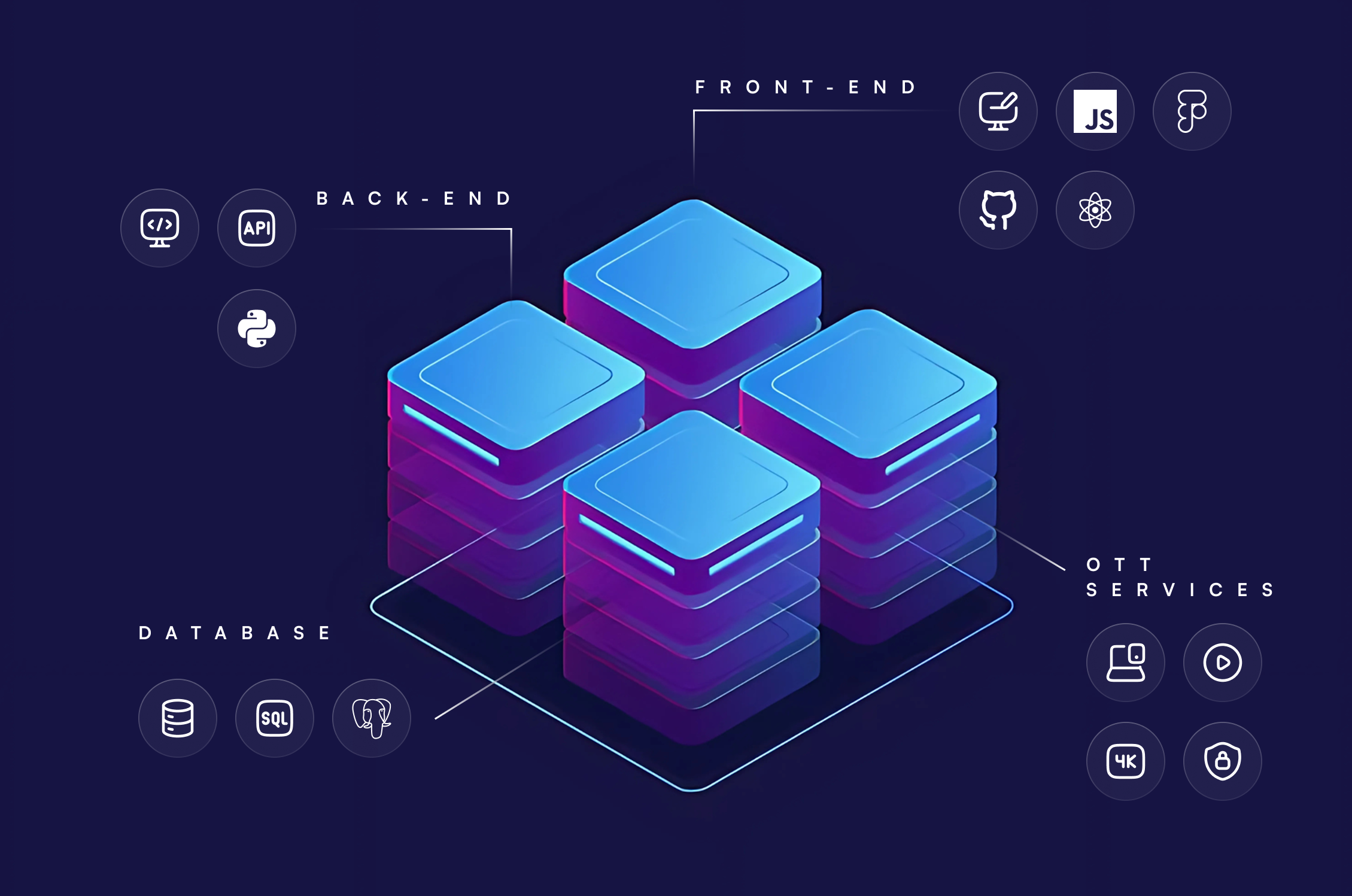
The front end is your users' first impression. High-quality user interfaces (UI) and smooth user experience (UX) are key. You want platforms that run beautifully on mobile, tablets, desktops, and TV devices.
Frameworks to consider:
- React.js: Highly flexible, used widely for scalable streaming platforms.
- Angular: Backed by Google, ideal for large, enterprise-level on-demand platforms.
- Vue.js: Lightweight, quick to integrate, ideal for projects needing rapid development.
Why it Matters: Superior front-end design distinguishes your media streaming services, ensuring users easily discover content, manage favorites, and engage with features like watchlists and search.
Back-End Technologies
The back end forms the “brain” of your platform, connecting users to content and enabling all interactive features.
Popular languages and frameworks:
- Node.js Excels at handling real-time data for live streaming app development.
- Python (with Django or Flask): Scalable, clean, and perfect for building VOD platforms or integrating AI-driven content recommendations.
- Ruby on Rails: Rapid prototyping, ideal for startups building subscription-based platforms.
- Java: Widely used for robust, high-performance OTT app development.
Databases:
- PostgreSQL, MySQL: Traditional and reliable for transactional data.
- MongoDB: Flexible and well-suited for unstructured data such as user preferences.
Microservices architecture:
Using microservices can boost deployment speed and resilience. This means your app is broken into smaller, manageable services connected via APIs, so you can update or scale specific parts of your platform without impacting the whole system.
Cloud-Based Streaming Services
The cloud is the backbone of scalable OTT platforms. Cloud-based streaming services like AWS, Google Cloud, and Azure deliver infrastructure you can scale up or down as traffic fluctuates.
Why the Cloud?
- Minimizes upfront hardware costs
- Offers automated scaling, backups, and disaster recovery
- Enables seamless global content delivery
Cloud media services:
- AWS Elemental Media Services, Google Cloud Media Translation, and Azure Media Services offer infrastructure and tools for end-to-end video processing.
Consider cloud-based white-label OTT solutions if you want speed to market and trusted, pre-built modules.
Streaming Technology Solutions
Broadcast quality rests on solid video transmission protocols.
- HLS (HTTP Live Streaming): Developed by Apple, it’s the standard for most modern multi-device streaming solutions, supporting adaptive bitrates across platforms.
- MPEG-DASH: An open standard for adaptive streaming, ensuring content can be played on any device, regardless of the manufacturer.
- WebRTC: If you’re focusing on real-time live streaming apps for collaborative or social experiences, this technology offers low-latency, browser-based communication.
Employing these protocols enhances your media streaming services with buffer-free playback and optimal video quality.
Finding the Right Development Team
Even the best tech stack is only as good as the team implementing it. Selecting an OTT app development company with a proven track record is essential.
- OTT app developers in India and OTT app developers in the USA both offer advantages. Indian firms are often recognized for rapid scaling and cost efficiency, while US developers may deliver unique insights into North American user behaviors and monetization models.
What to look for:
- Experience in live streaming app development, VOD services, and subscription management
- Expertise in cloud-based streaming services, multi-cloud solutions, and integration with leading CDNs
- A portfolio including diverse media streaming services and complex, cross-platform OTT app development
- Positive client testimonials and transparent support channels
Why Choose Regal Streaming Solution Company?
At Regal Streaming Solution Company, we bring passion, expertise, and innovation to every OTT platform we build. As an industry-leading OTT app development company, we’ve empowered clients worldwide with:
- Custom OTT solutions for media, education, sports, and entertainment sectors
- Secure and scalable streaming platforms engineered for growth, security, and peak performance
- Tailor-made streaming technology solutions and seamless integration for personalized user experiences
- State-of-the-art real-time live streaming apps and on-demand video platforms suited for today’s interactive viewers
Our team stands apart thanks to:
- A collaborative approach—we guide you from concept and OTT platform design and development through launch and optimization
- Robust cloud-based streaming services that deliver reliability and speed
- Advanced analytics, allowing you to track user engagement, measure ROI, and optimize content offerings
- Dedicated support for IP-based video delivery solutions, white-label OTT solutions, and adaptable frameworks to enhance your brand
Whether you want a nimble solution to test the waters or are ready to scale globally, Regal Streaming Solution Company can turn your idea into a profitable, resilient platform.
Final Thoughts
Choosing the right tech stack is the defining moment in your OTT journey.
It impacts user experience, security, scalability, and the revenue potential of your service. Start by clearly defining your business goals and audience. Select technologies that empower high-quality streaming services, adaptable multi-device support, and robust security. Work with an OTT app development company that has the expertise and resources to execute your vision, from cloud-based streaming services to customizable OTT platforms and beyond.
Ready to transform your streaming vision into reality? Contact Regal Streaming Solution Company today, the best OTT development company, and let us help you build the next industry-leading OTT platform.


