



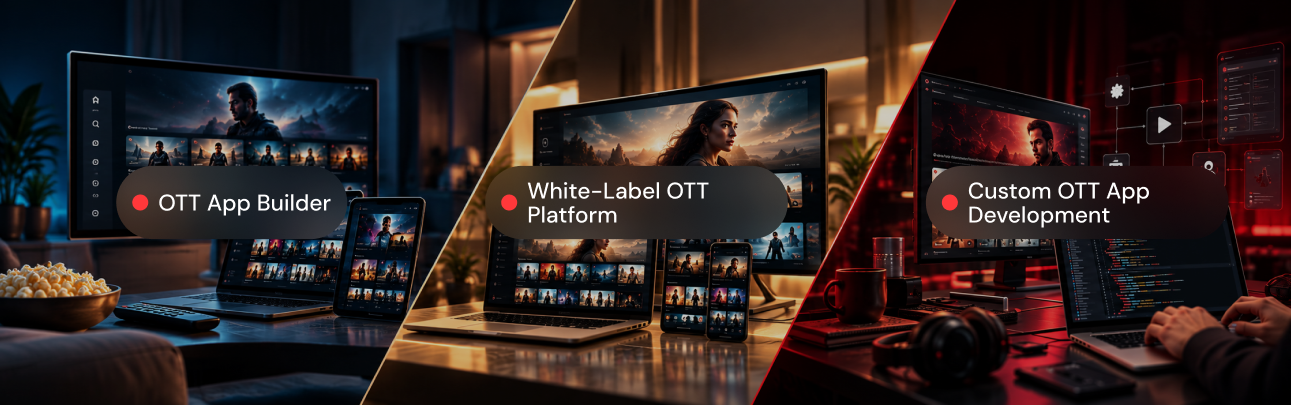
There is no single “best” OTT development model in 2026. The global video streaming market is estimated at $191.1 billion in 2026 and is projected to reach $416.8 billion by 2030, a 21.5% CAGR. At the same time, the business model is becoming harder to sustain: Deloitte reports that 41% of US consumers cancelled an SVOD service in the previous six months, while 68% of SVOD subscribers now use at least one ad-supported service.
That brings the choice down to an OTT app builder, a white-label OTT solution, or custom OTT development. An OTT app builder usually suits businesses that prioritize speed and configuration. A white-label OTT solution is suited to businesses that want an established streaming product under their own brand. Custom OTT development is suited to businesses whose workflows, integrations, UX, or ownership requirements cannot be met by an existing solution. The important comparison is not simply development price, but it is total cost, control, scalability, maintenance, and exit flexibility.
Consider a media company with 5,000 subscribers paying $10 per month. That business generates $600,000 in annual OTT revenue, but it still needs to account for apps, hosting, CDN, DRM, analytics, maintenance, and content operations. The development model can therefore affect the economics of the business long after the initial launch.
This guide compares the three approaches across 21 practical factors. The goal is to help you choose an OTT development approach based on your actual business requirements and three-year total cost of ownership, rather than an advertised starting price.
OTT App Builder vs White-Label OTT Platform vs Custom OTT App Development
Factor | OTT App Builder | White-Label OTT Solution | Custom OTT App Development |
How it works | Configure pre-built OTT features, templates, and workflows | Launch an existing OTT solution under your brand | Design and develop the OTT product around your requirements |
Best suited for | Businesses prioritizing speed and standard OTT functionality | Businesses wanting a branded service without building every component from scratch | Businesses with unique workflows, integrations, or product requirements |
Customization | Limited to available configuration and extension options | Varies by provider, especially with source-code/API access | Custom UI, workflows, APIs, and business logic can be developed |
Source-code access | Usually limited or unavailable | Depends on licensing and contract terms | Can be transferred to the business under the development agreement |
Infrastructure control | Usually controlled by the provider | SaaS: provider-controlled; self-hosted: customer-controlled | Can be designed around the customer's infrastructure |
Hosting model | Usually managed SaaS | SaaS or self-hosted, depending on provider | Customer-owned, cloud-managed, or managed by a development partner |
Web & mobile apps | Depends on supported templates/platforms | Depends on the provider and package | Developed for the required platforms |
Monetization | Available models depend on the builder | Usually supports common OTT models; verify specific requirements | Monetization logic can be built around the business model |
DRM & security | Provider-dependent | Provider-dependent or separately integrated | DRM/security architecture can be selected and integrated |
Analytics & data access | Depends on provider | Depends on provider, plan, and hosting model | Can be designed around required data and analytics |
Maintenance | Primarily provider-managed | Provider-managed, shared, or customer-managed depending on model | Requires an internal team or development/maintenance partner |
Recurring platform fees | Common | Common for SaaS; not necessarily applicable in the same way to self-hosted models | No platform subscription by default, but maintenance and infrastructure costs remain |
Usage-based costs | May include bandwidth, storage, subscribers, transactions, or other usage fees | Varies by provider and deployment model | Infrastructure and third-party service costs generally scale with usage |
Migration difficulty | Depends on data/API/export capabilities | Depends heavily on source code, data, infrastructure, and contract terms | Potentially easier if the business controls the code, data, and infrastructure |
Upfront investment | Typically lower | Varies by provider and deployment model | Typically higher |
Primary trade-off | Speed and simplicity vs. customization/control | Faster deployment vs. varying levels of ownership and dependency | Control and customization vs. development and maintenance effor |
1. How It Works
Custom OTT:
The development team designs and builds the required website, apps, backend, content management, and monetization workflows. The scope is defined by the business rather than limited to a pre-existing OTT product.
OTT app builder:
You configure existing functionality using templates, dashboards, and supported integrations. The amount of development required depends on how closely the available features match your requirements.
White-label OTT:
You launch an existing streaming solution under your brand. The provider may supply the website, mobile apps, CMS, and monetization features. Some solutions are SaaS; others can be deployed in your own hosting environment.
Decision rule:
Use an app builder when existing features meet your requirements. Consider white-label OTT when you need an established branded streaming solution. Choose custom development when essential product requirements cannot be met through configuration or supported customization.
2. Best Suited For
Custom OTT:
Businesses treating streaming as a core product, particularly when proprietary workflows, complex integrations, or differentiated user experiences are central to the business model.
OTT app builder:
Creators, educators, membership businesses, and smaller media companies testing a streaming business with standard functionality.
White-label OTT:
Content owners, broadcasters, production companies, sports organizations, and media businesses that want to launch their own branded streaming service without building every component from scratch.
Decision rule:
Identify your essential requirements first. If most are standard, evaluate existing solutions before funding a custom build. If the requirements that existing solutions cannot meet are central to your business, assess custom development.
3. Launch Effort and Time
Custom OTT:
Requirements discovery, design, development, integration, testing, deployment, and app-store release all contribute to the timeline. Each additional application or specialized workflow can add work.
OTT app builder:
Launch effort is generally lower when the required features, templates, and integrations are already available. Configuration, content uploads, payment setup, and app publishing still need to be completed.
White-label OTT:
Branding and configuring an established product can reduce development effort. However, content migration, integrations, app availability, and deployment requirements still affect delivery time.
Decision rule:
Ask each vendor to quote the same launch scope, including every required app, monetization model, DRM requirement, integration, and content migration. Compare the delivery milestones, not just the advertised number of days.
4. Customization
Custom OTT:
The team can develop specific UI designs, user journeys, business rules, APIs, analytics, and content workflows, subject to the agreed scope and technical constraints.
OTT app builder:
Customization usually depends on available settings, templates, plugins, and APIs. A requirement outside those capabilities may need a workaround or may not be possible.
White-label OTT:
Customization varies by provider. Some solutions allow extensive configuration; others restrict changes to branding and supported integrations. Source-code access, where available, can expand the options.
Decision rule:
List your must-have customizations before comparing vendors. Ask the provider to demonstrate each requirement in a working product and identify any paid development or unsupported functionality.
5. Source-Code Access and Ownership
Custom OTT:
Source-code ownership or transfer can be included in the development agreement. The contract must clarify intellectual-property rights, third-party components, reuse rights, and ownership of custom modifications.
OTT app builder:
Customers typically configure the provider's software rather than receive its underlying source code. Access depends on the provider's licensing and product model.
White-label OTT:
White-label branding does not guarantee source-code access. Some agreements provide a license to use the software; others may provide source-code access or broader rights.
Decision rule:
If ownership matters, get the exact rights in writing. Confirm whether you can modify the code, hire another developer, deploy it elsewhere, and continue operating if the original provider relationship ends.
6. Infrastructure Control
Custom OTT:
The architecture can be designed for a customer-controlled cloud account, a managed environment, or another agreed deployment model. Control depends on who owns and administers the infrastructure.
OTT app builder:
Hosting is generally managed by the provider. The customer may have limited visibility or control over infrastructure configuration.
White-label OTT:
SaaS deployments generally leave infrastructure management with the provider. Self-hosted deployments can give the customer control of the hosting environment, depending on access rights and the implementation agreement.
Decision rule:
If you require your own cloud account, network configuration, or infrastructure policies, verify these requirements before selecting a solution. Do not assume custom development or white-label software automatically provides infrastructure ownership.
7. Hosting Model
Custom OTT:
Hosting may run in the customer's cloud account, be managed by a development partner, or use a combination of managed services. The chosen model affects responsibility for operations and support.
OTT app builder:
The provider usually manages the hosting environment, allowing the business to focus on content and subscribers rather than infrastructure operations.
White-label OTT:
SaaS typically bundles software access with provider-managed hosting. Self-hosted licensing places more of the deployment and infrastructure responsibility on the customer or its technical partner.
Decision rule:
Choose based on your need for control and your capacity to manage operations. If you want minimal infrastructure responsibility, evaluate managed hosting. If you need infrastructure control, confirm who handles updates, security, backups, monitoring, and incident response.
8. Web and Mobile Applications
Custom OTT:
Web, iOS, and Android applications can be developed to meet specified UX, authentication, playback, accessibility, and integration requirements.
OTT app builder:
Available apps depend on the builder's supported templates, features, and subscription plan. A mobile-responsive website is not necessarily equivalent to native mobile apps.
White-label OTT:
The provider may offer branded web and mobile applications, but availability, customization, app fees, and release responsibilities differ between packages.
Decision rule:
Ask for a device-by-device list of included applications. Confirm whether the quote covers development, branding, app-store submission, updates, and ongoing compatibility work.
9. TV Applications
Custom OTT:
The development team can build for selected TV ecosystems, such as Android TV, Fire TV, Apple TV, Samsung TV, LG TV, or Roku, subject to scope and technical requirements.
OTT app builder:
TV support depends on the existing product and supported devices. A web player or mobile app does not automatically provide a TV application.
White-label OTT:
Some providers offer TV apps as part of selected packages or as paid additions. Verify the exact operating systems and whether the apps are branded and publishable under your business.
Decision rule:
Start with the TV devices your audience actually uses. Request a working demonstration for each target ecosystem and a clear breakdown of app costs, publishing, testing, and maintenance.
10. Monetization
Custom OTT:
The business can develop the required combination of subscriptions, advertising, rentals, pay-per-view, promotional offers, and other payment workflows.
OTT app builder:
Monetization is limited to the models and payment integrations supported by the product. Additional business rules may not be configurable.
White-label OTT:
Established solutions often support common OTT models, but availability depends on the plan and provider. For example, Vimeo OTT's published pricing page distinguishes its Starter offering from Enterprise features, including broader monetization and distribution options.
Decision rule:
Choose a solution that supports your current revenue model and any realistic near-term changes. Verify payment gateways, supported currencies, refunds, taxes, coupons, app-store billing, transaction fees, and revenue-share terms.
11. Video Infrastructure
Custom OTT:
The architecture can use selected video-processing, storage, packaging, and CDN services. The business or its technical partner must manage the chosen integrations and operating costs.
OTT app builder:
Video infrastructure is often bundled or provider-managed, but included storage, encoding, bandwidth, and concurrency limits vary.
White-label OTT:
SaaS may bundle delivery within specified limits. Self-hosted deployments can give the customer more choice over cloud infrastructure and CDN arrangements, while increasing responsibility for operations.
Decision rule:
Compare infrastructure allowances and overage rates using the same expected viewing hours, video quality, audience geography, and peak concurrency. Ask what happens when usage exceeds the included allocation.
12. DRM and Security
Custom OTT:
Required DRM systems and security controls can be selected and integrated into the architecture. The business must still budget for licensing, implementation, testing, and ongoing maintenance.
OTT app builder:
DRM and security capabilities depend on the provider, supported devices, and subscription plan.
White-label OTT:
DRM may be included, separately priced, or dependent on the selected deployment and package. A general claim of “DRM support” does not establish support for every device or use case.
Decision rule:
Verify the required DRM systems, device coverage, license management, offline playback, geo-restriction, and any watermarking requirements. Ask which components are included in the quotation and which carry separate fees.
13. APIs and Integrations
Custom OTT:
APIs and integrations can be developed for the required CRM, payment systems, identity provider, analytics, marketing tools, or enterprise software.
OTT app builder:
Integration options depend on exposed APIs, webhooks, plugins, and plan restrictions. A supported connector may be available, while a custom integration may not be.
White-label OTT:
API access and integration permissions vary by vendor. Some providers include APIs in selected plans; others restrict access or charge for additional work.
Decision rule:
Document the systems your OTT service must connect to. Ask for API documentation, authentication methods, rate limits, webhooks, and any extra licensing or implementation fees. Confirm the integration works in the intended production workflow.
14. Analytics and Data Access
Custom OTT:
Analytics can be designed around required business questions, such as subscriber retention, viewing completion, content performance, conversion, and revenue attribution.
OTT app builder:
You generally use the reporting features and exports provided by the vendor. Access to raw events or external analytics integrations may be limited.
White-label OTT:
Analytics and data exports depend on the product, plan, deployment model, and contractual rights.
Decision rule:
Identify the data you need to operate the business and measure performance. Confirm whether you can export subscriber records, viewing events, transactions, and content metadata in usable formats—not just view summaries in a dashboard.
15. Maintenance and Technical Support
Custom OTT:
The business needs a development team or maintenance partner for bug fixes, security patches, operating-system changes, integrations, and new features.
OTT app builder:
The provider typically maintains the underlying software. Customers still need to manage content, configurations, business operations, and any unsupported custom work.
White-label OTT:
Responsibility may sit with the provider, the customer, or both. A self-hosted product can still include technical support, but the support scope must be defined.
Decision rule:
Ask who is responsible for production incidents, security updates, app compatibility, backups, and urgent fixes. Compare support hours, response commitments, exclusions, and whether maintenance is included in the quoted price.
16. Recurring Platform Fees
Custom OTT:
There is no inherent SaaS platform subscription when software is developed for the customer, but cloud infrastructure, third-party licenses, maintenance, and support can still be recurring expenses.
OTT app builder:
Monthly or annual subscription fees are common. The price may vary by plan, apps, usage, or selected features.
White-label OTT:
SaaS generally involves recurring subscription fees, while self-hosted licensing may follow a different payment structure. Do not assume that every self-hosted product is a one-time purchase or that every SaaS plan has a fixed total cost.
Decision rule:
Request a complete three-year cost projection. Separate one-time charges, recurring licenses, app fees, usage fees, support, and optional services. Confirm the renewal terms and any annual price adjustments.
17. Usage-Based Costs
Custom OTT:
Infrastructure, video processing, payment processing, DRM, and other third-party costs can rise with viewing hours, traffic, storage, or transactions.
OTT app builder:
Usage charges may apply to bandwidth, storage, video processing, subscribers, or transactions, depending on the provider.
White-label OTT:
Some providers bundle selected allowances and charge for excess usage; others use subscriber-based or revenue-linked pricing. For example, Vimeo OTT documents its subscriber and transaction fees, making the relationship between subscriber volume and cost important to evaluate.
Decision rule:
Model costs at several business stages, such as 1,000, 10,000, and 50,000 subscribers, using realistic viewing and transaction assumptions. Do not compare providers using subscriber count alone if their billing units differ.
18. Vendor Dependency
Custom OTT:
Dependence on the original developer can be reduced through proper code ownership, documentation, automated deployment, and handover. Poor documentation or proprietary dependencies can still make switching expensive.
OTT app builder:
Dependence is often significant because the software, hosting, and available features are controlled by the provider.
White-label OTT:
SaaS generally creates greater dependence on the provider's operating environment. Self-hosting and source-code access can reduce some dependencies, but licensing, proprietary components, and support arrangements still matter.
Decision rule:
Ask what would happen if the vendor stopped supporting your account tomorrow. Confirm which assets, credentials, code, data, and documentation you would retain and whether another technical team could continue operating the service.
19. Migration Difficulty
Custom OTT:
Migration can be easier when the business controls its code, database, content, deployment process, and documentation. It can still require substantial work if the architecture is tightly coupled to third-party services.
OTT app builder:
Migration depends on data-export options, API access, content formats, and whether the replacement system can reproduce the existing workflows.
White-label OTT:
Migration depends on the contract, software license, database access, source-code rights, infrastructure, DRM configuration, and app ownership.
Decision rule:
Ask the provider to explain the exit process before signing. Request sample exports and clarify migration assistance, termination charges, app transfer, subscriber records, payment continuity, and downtime responsibilities.
20. Upfront Investment
Custom OTT:
Usually requires a larger initial budget because discovery, design, development, integration, and testing must be funded before launch.
OTT app builder:
Usually requires less initial engineering investment when the product already supports the required functionality.
White-label OTT:
Upfront costs vary. A SaaS service may have limited setup costs, while self-hosted deployment or substantial customization may require implementation and infrastructure expenditure.
Decision rule:
Compare the total investment required to reach the same launch scope. Include apps, integrations, content migration, testing, and initial support instead of comparing only software license or development fees.
21. Long-Term Flexibility
Custom OTT:
Offers the potential for substantial technical flexibility, provided the business has the rights, documentation, and resources needed to change the product.
OTT app builder:
Flexibility is limited by the builder's supported features, extension mechanisms, and product roadmap.
White-label OTT:
Flexibility depends on source-code access, API availability, customization rights, licensing, and whether the software is SaaS or self-hosted.
Decision rule:
Identify the changes you reasonably expect to need over the next three years. If those changes require capabilities the product does not support, compare the cost of workarounds against custom development or a more flexible deployment model.
Final Buying Decision Across Custom Development Vs. White Label Vs. OTT App Builder
Custom OTT:
Consider it when unique product requirements justify the initial engineering investment and the business can support ongoing development.
OTT app builder:
Consider it when standard features are sufficient and speed, simplicity, and reduced engineering work are the main priorities.
White-label OTT:
Consider it when you need an established branded streaming service. Evaluate SaaS and self-hosted options separately if hosting control, source-code access, or recurring platform fees are important.
Decision rule:
Choose using four measures:
the cost to launch,
the three-year total cost of ownership,
the control you need,
the cost of leaving or changing the provider.
No model is automatically the least expensive or most suitable for every business.
Real Example: How to Choose the Right OTT Development Approach
Scenario:
A media company has 5,000 subscribers paying $10/month, generating $50,000/month or $600,000/year. It needs web, mobile, and TV apps, VOD, subscriptions, DRM, analytic,s and ongoing content operations. The company now has three ways to build its OTT business, and the important question is not only the initial development price but also who carries the technology, hosting, maintenance,ce and employee overhead after launch.
Costing: What the Same OTT Business Pays For

Published examples:
Muvi lists plans from $399/month, with additional apps priced separately; Vimeo OTT lists $1/subscriber/month for SVOD and transaction-based TVOD pricing. These are examples of published managed-OTT pricing, not universal market prices. Muvi pricing; Vimeo OTT pricing breakdown
ROI: Same $600K Revenue, Different Cost Structure
Because white-label and custom projects have no universal public price, the table below uses illustrative Year-1 costs to show how ROI should be calculated—not claimed market prices.

*Illustrative calculation: (Revenue − technology cost) ÷ technology cost × 100. It excludes content, marketing, payment processing, and other business expenses, so it should not be presented as guaranteed business ROI.
Decision Rule
Choose an OTT app builder → when speed and low initial technical effort are the priority.
Choose white-label OTT → when you want a branded OTT business without carrying the full cost and responsibility of custom engineering.
Choose custom development → when your unique technology, workflows,s or integrations justify the additional development and employee overhead.
The right choice is not the cheapest way to launch. It is the model whose total cost, ownership and technical responsibility fit your expected revenue and business requirements.
Conclusion
Ultimately, choosing between an OTT app builder, white-label OTT solution, and custom OTT development depends on your required level of speed, control, ownership, customization, and long-term cost. An app builder can reduce initial technical effort, white-label can provide a faster path to a branded streaming service, while custom development offers the greatest flexibility but requires higher investment and ongoing technical responsibility. The right approach is the one that fits your expected revenue, technical requirements, and three-year total cost of ownership, not simply the lowest upfront price.


