



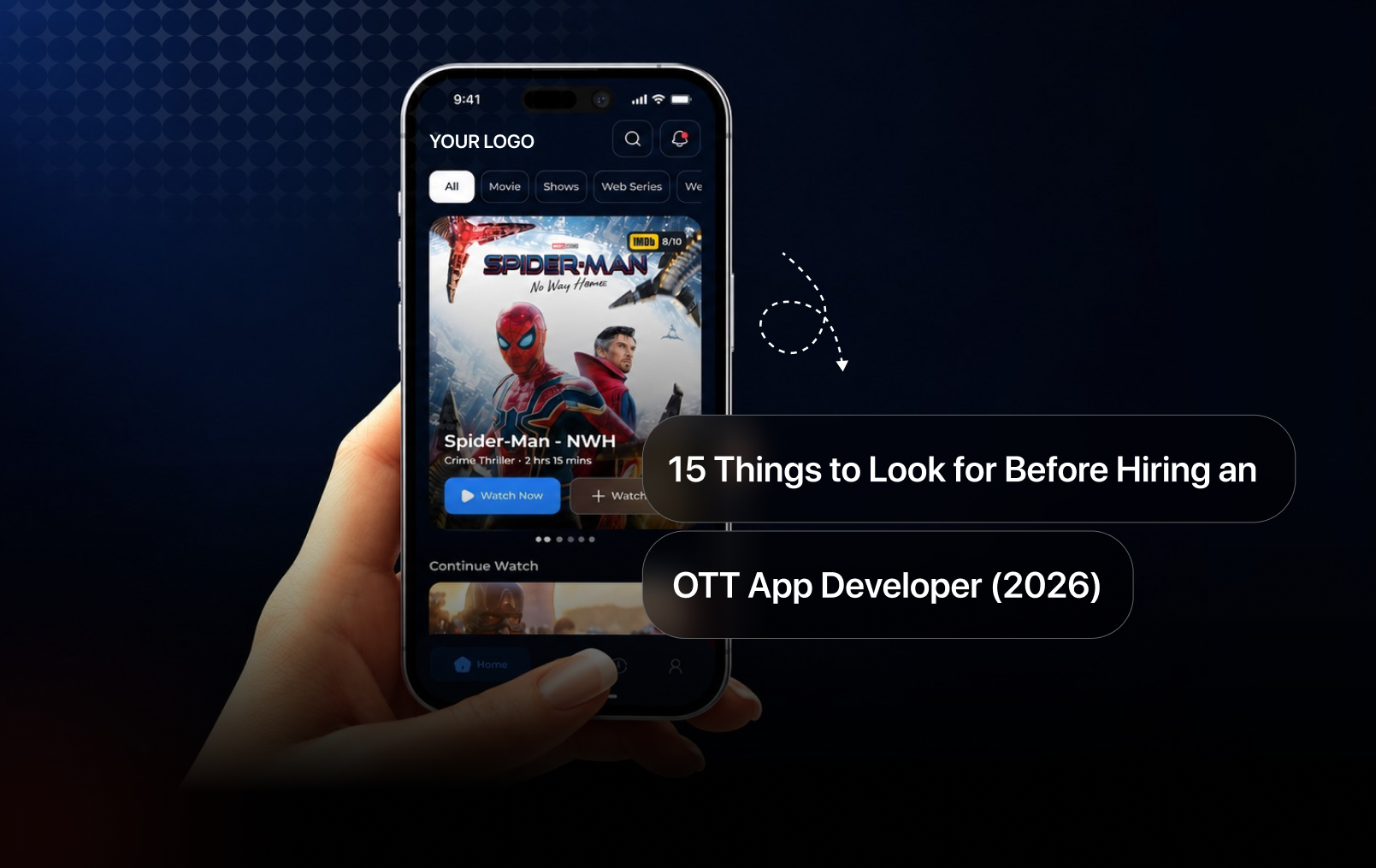
The OTT market requires more than a mobile app developer. Your chosen partner must understand video streaming, content delivery, DRM, monetization, and cross-platform playback. In the United States, the Bureau of Labor Statistics projects 10% employment growth for software developers, QA analysts, and testers from 2025 to 2035,
with approximately 106,100 openings annually across these occupations. This is broader software employment data, not OTT-specific hiring demand, so it should not be presented as a count of OTT developers.
The right OTT App developer depends on your platform requirements, technical scope, budget, and long-term support needs. Before hiring, evaluate the following 15 criteria.
1. Proven OTT Development Experience
Don't hire an app developer just because they have built several mobile apps. Verify their experience delivering streaming products.
What to Look For::
Live OTT app links, not only screenshots or demo videos.
The exact features they implemented: playback, CMS, subscriptions, DRM, or live streaming.
A reference project with a similar content model and audience.
The developer's personal contribution if they worked for an agency.
Expert hiring check:
Ask the OTT developer to explain one production issue they solved, such as playback failures, app-store compatibility, or subscription entitlement errors. Their explanation should demonstrate practical experience rather than a list of technologies.
2. Experience With Your Target Platforms
A web player is not proof of Smart TV or mobile OTT expertise.
List your required platforms before requesting a quote:
Web, Android, iOS
Android TV and Fire TV
Apple TV, Roku, Samsung Tizen, LG webOS, if required
Ask for a platform-by-platform delivery plan. Verify which platforms use native players, shared code, or separate implementations.
Expert hiring check:
Ask whether a single playback issue can affect multiple platforms and how they maintain consistent playback, login, subscription access, and resume position across devices.
3. Streaming Architecture, Not Just App Development
Your OTT app is the playback client; the streaming system delivers the content.
Have the developer map out the complete flow:
Content upload → Encoding → Packaging → Storage/Origin → CDN → Player → Entitlement/DRM.
For VOD and live streaming, clarify:
HLS or DASH and supported device requirements.
Encoding and adaptive bitrate ladder.
Live latency requirements.
Content processing and failed-job handling.
Player error reporting and monitoring.
Apple's HLS documentation confirms that streaming requires encoded media, playlists, and a web server or CDN, with adaptive playback designed for changing network conditions.
Expert hiring check:
Ask the developer to draw the architecture for one VOD playback request and one live-streaming request. A proposal that only describes app screens is incomplete.
4. CDN, Scaling and Playback Reliability
Don't ask only, "Can your platform handle 100,000 users?" Ask what the number means.
Clarify:
Concurrent viewers vs. registered users.
Expected peak viewing traffic.
CDN and origin configuration.
Cache strategy and delivery cost.
Monitoring and incident response.
Load testing scope and assumptions.
Streaming performance depends on network delivery and playback conditions, not just backend server capacity. The IETF's streaming operational guidance discusses the distinct networking and quality-of-experience challenges of high-bitrate media.
Expert hiring check:
Ask for a load-testing plan tied to your expected peak concurrency and bitrate assumptions. Don't accept an unsupported scalability number.
5. DRM and Content Protection
DRM is a compatibility and licensing decision, not simply a checkbox.
Verify:
Which DRM systems are required for your target devices?
Which encryption and packaging formats will be used?
How are licenses issued and renewed?
What happens when a license request fails?
Are offline downloads covered by the DRM design?
Widevine, FairPlay, and PlayReady support varies by platform and playback implementation. Android Media3 documents DRM format and platform compatibility requirements, while Apple's documentation covers FairPlay content protection.
Expert hiring check:
Request a device-by-DRM compatibility matrix. A provider claiming “multi-DRM support” should explain which devices and playback paths have actually been tested.
6. Monetization and Entitlement Experience
A payment success does not automatically mean the viewer can watch the content.
Verify how the developer will manage:
Subscription plans and entitlements.
Payment verification and renewal events.
Failed payments and cancellations.
App-store billing restrictions.
Web-to-app account synchronization.
PPV or rental access expiration.
Expert hiring check:
Ask the developer to explain what happens when a user pays successfully, but the payment webhook is delayed, duplicated, or fails. Confirm how access is reconciled without giving unintended access or charging twice.
7. CMS and Content Operations
A production OTT business needs a reliable content workflow, not just an upload button.
Verify whether your team can:
Upload and process videos.
Manage metadata, seasons, and episodes.
Schedule releases and publish content.
Manage subtitles, audio tracks, and artwork.
Restrict content by subscription or territory.
Review failed processing jobs.
Expert hiring check:
Ask how the system handles a video upload that completes storage but fails during encoding. Who sees the error, can it be retried, and is the content prevented from being published incorrectly?
8. Analytics and Playback Quality Monitoring
Total watch time alone cannot explain why viewers leave.
Check both business and playback metrics:
Watch time, completion, and churn.
Subscription conversion and revenue.
Playback startup time.
Rebuffering and playback failures.
Device, OS, and network breakdowns.
The IETF's streaming guidance treats quality of experience as a distinct operational concern, which supports evaluating playback metrics alongside business analytics.
Expert hiring check:
Ask to see a sample playback-quality report. Confirm whether your team can identify whether a problem is related to the player, CDN, device, or network.
9. Security and User Access Controls
A secure OTT platform must control access to content and administrative systems.
Verify:
Authentication and session management.
Role-based CMS permissions.
API access controls.
Device and concurrent-stream policies.
Secure handling of payment and user data.
Expert hiring check:
Ask what happens when a user logs out, changes their subscription, exceeds the device limit, or loses access to a purchased title. Access rules should be defined and tested, not left to assumptions.
10. Playback UX and Cross-Device Continuity
A visually attractive OTT app can still deliver a poor viewing experience.
Test:
Startup time and buffering.
Continue Watching and resume position.
Subtitles and multiple audio tracks.
Orientation and remote navigation on TV.
Offline downloads, if required.
Apple documents playback, buffering, AirPlay, and protected-content handling as distinct technical considerations in its streaming frameworks.
Expert hiring check:
Test the same account on web, mobile, and TV. Verify that playback position, access permissions, and user settings behave as promised.
11. Testing Across Devices and Network Conditions
A successful test on one phone does not validate an OTT product.
Request a documented test matrix covering:
Target devices and OS versions.
Wi-Fi and mobile networks.
Playback interruption and resume.
Subscription and payment failure flows.
Live-stream start, reconnection, and end.
App crashes and release regression.
Expert hiring check:
Ask for defined acceptance criteria and defect severity levels. Clarify who is responsible for fixing issues found after the launch milestone.
12. App Store and TV App Publishing
Publishing is part of delivery, not an afterthought.
Confirm:
Which stores and TV platforms are included.
Who manages developer accounts.
App review and rejection handling.
Required privacy disclosures and billing compliance.
Update and release responsibilities.
Expert hiring check:
Ask the developer to identify platform-specific restrictions that could affect your subscription model or app features before development begins.
13. Source Code, Data and Infrastructure Ownership
Clarify ownership before development begins—not when you want to change vendors.
Put these terms in writing:
Source code and repository access.
Cloud accounts and infrastructure permissions.
Database and content ownership.
App-store account control.
Third-party licenses and dependencies.
Documentation and handover obligations.
Expert hiring check:
Ask, "If we stop working together, can another qualified team deploy, maintain, and migrate this platform using the delivered code and documentation?"
For a self-hosted white-label OTT solution, distinguish actual hosting and access rights from marketing claims about ownership.
14. Total Cost Beyond Development
The initial app quote is not the total cost of operating an OTT service.
Request a line-item estimate for:
Development and maintenance.
Cloud infrastructure, storage, and CDN.
Video encoding and DRM.
Payment and third-party service fees.
App-store and platform-specific work.
Support and monitoring.
Expert hiring check:
Ask which costs are usage-based, which are fixed, and which third-party accounts you pay directly. Require assumptions for expected video volume, streaming hours, and peak traffic.
15. Post-Launch Support and SLA
Launch support should cover real operational problems, not only bug fixes in the app UI.
Clarify:
Critical playback incident response.
Infrastructure and monitoring responsibilities.
OS and app-store updates.
Bug-fix period and maintenance scope.
Escalation process and support hours.
Source-code and operational handover.
Expert hiring check:
Ask for a written support scenario: "If paid users cannot play videos during peak hours, who is contacted, what is monitored, and what response time applies?"
How to Hire an OTT App Developer: Company vs Freelancer vs Marketplace
Your hiring model affects who is responsible for architecture, QA, deployment, and fixing production problems. For an OTT product, compare delivery responsibility—not simply hourly rates.

What experienced buyers check before hiring.
1. Ask for a live product—not just screenshots. A live app lets you inspect playback, login, subscription access, and cross-device behavior.
2. Meet the people doing the work. If an agency sells the project, ask to speak with the engineers responsible for the streaming architecture and deployment.
3. Keep the repository under your control. Create or own the source-code repository, and require regular commits, documentation, and milestone reviews. This reduces the risk of losing access if a freelancer becomes unavailable.
4. Test a meaningful technical milestone. Before committing to the full build, define a deliverable such as authenticated playback, a working CMS-to-player flow, or a subscription entitlement test. Review the implementation against agreed acceptance criteria.
5. Compare the complete delivery cost. Include development, cloud, CDN, DRM, testing, publishing, and post-launch support. A lower initial quote is not necessarily a lower total project cost.
Which hiring option should you choose?
Use the project scope and your ability to manage technical risk as the decision criteria.
A freelancer may fit a narrowly defined task with clear acceptance criteria.
A company may fit a project requiring several specialists, coordinated delivery, and continuing support.
A marketplace is a way to find providers; it does not replace technical vetting.
There is no universal rule that an agency always delivers better results than a freelancer. The quality of the actual team, architecture, contract, and delivery process matters more than the label.
Practical hiring question:
Who will be accountable if the OTT app works in development but fails during real-world playback, subscription processing, or a production release?
How to Choose a Country for OTT App Development
The best development location depends on your project complexity, budget, communication needs, compliance requirements, and post-launch support, not nationality alone. Compare OTT providers based on their proven OTT experience, technical team, delivery process, and total project cost.

What matters more than the provider's country?
Check whether the development team can handle your actual OTT requirements:
Streaming: VOD, live streaming, encoding, CDN integration, and playback reliability.
Platforms: Web, iOS, Android, Android TV, Fire TV, Roku, or Smart TV, depending on your target audience.
Monetization: Subscription billing, payment webhooks, entitlement management, and failed-payment handling.
Content protection: DRM requirements and compatibility across supported devices.
Ownership: Source code, cloud infrastructure, user data, and deployment credentials.
Support: Response times for playback failures, payment issues, app-store rejections, and production incidents.
Example: How location affects hiring
A business launching a web and Android OTT MVP may be able to work effectively with an individual specialist or a small remote team. However, a service requiring web, iOS, Android TV, live streaming, DRM, subscriptions, CMS, and ongoing support needs a clearly accountable team with expertise across several technical areas.
The deciding factor is not simply whether the provider is based in the USA, India, UAE, or UK. Ask each provider for a comparable proposal covering:
Development scope and delivery milestones.
Streaming and application architecture.
One-time development and recurring infrastructure costs.
Source-code and infrastructure ownership.
Testing, deployment, and post-launch support.
Hiring principle:
Choose the provider that can demonstrate relevant OTT delivery experience, clearly define responsibility, and support your target market—not simply the provider from a particular country.
There is no reliable basis to claim that one of these countries is universally the best location for OTT app development. Use verifiable project evidence, comparable proposals, and clearly defined contractual terms when making your decision.
Conclusion:
Choosing an OTT app development partner requires more than comparing prices or countries. Evaluate proven OTT experience, streaming architecture, platform compatibility, DRM, monetization, ownership, total costs, and post-launch support. Whether you hire a company, freelancer, or marketplace provider, choose a team with verifiable experience and clear delivery responsibilities.
Regal Streaming Solutions helps businesses launch their own branded OTT platforms through a self-hosted, white-label solution for web, mobile, and TV. With platform ownership, content management, monetization, and streaming support, Regal offers an alternative to building every OTT component from scratch. Compare your requirements and request a detailed proposal before choosing your development partner.


