

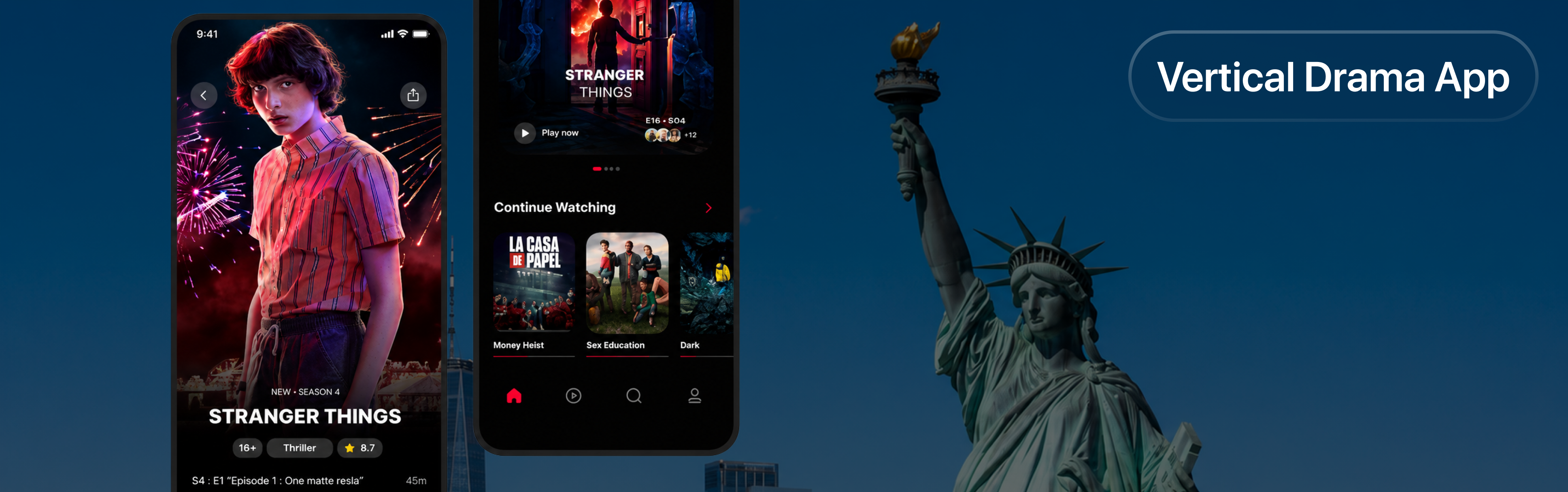
If you're planning to build a vertical drama app like ReelShort, one of the first questions you'll ask is: How much will it actually cost? The answer isn't a fixed number. Development costs vary based on the features you build, the platforms you support, your streaming infrastructure, and how quickly you want to scale. While some startups launch with a vertical drama MVP under $100,000, enterprise-grade platforms with AI recommendations, advanced analytics, and large-scale streaming can require investments well beyond $300,000.
This guide breaks down the real cost of building a vertical drama app in the USA in 2026, including feature-by-feature development estimates, infrastructure costs, hidden expenses, and the biggest factors that influence your budget. Whether you're a startup founder, media company, or OTT business, you'll leave with a realistic framework for planning your investment and avoiding costly mistakes before development begins.
How much does it actually cost to build a vertical drama OTT app in the USA?
A vertical drama app in the USA typically costs $20,000 to $500,000+, depending on your development approach. A self-hosted white-label OTT platform generally costs $20,000–$60,000+, while a custom-built vertical drama app typically ranges from $60,000 for an MVP to $500,000+ for an enterprise-grade streaming platform with AI, DRM, and advanced analytics.
Why Are Vertical Drama Apps Growing So Quickly in the United States?
This isn't simply another content trend. It's a shift in viewer behavior.
According to Omdia's 2026 Media & Entertainment research, the global micro-drama market generated approximately $11 billion in revenue in 2025 and is expected to reach $14 billion by the end of 2026. More importantly for founders, the United States has become the largest international market outside China, accounting for an estimated $1.5 billion in annual micro-drama revenue by 2026.
What's even more surprising is how users engage with these platforms.
Omdia's analysis of Sensor Tower mobile usage data found that in Q4 2025, ReelShort users in the U.S. spent an average of 35.7 minutes per day inside the app. By compariso
Several factors are driving this rapid growth in the U.S.:
1. Mobile-first viewing habits:
Viewers increasingly consume entertainment on smartphones during short breaks, commutes, or while multitasking.
2. Binge-worthy storytelling:
Episodes lasting one to three minutes create continuous cliffhangers that encourage users to watch "just one more episode."
3. Flexible monetization:
Unlike traditional streaming services that rely mainly on monthly subscriptions, vertical drama platforms combine subscriptions, virtual coins, pay-per-episode unlocks, and in-app purchases.
4. Lower production costs:
Compared with traditional television series, vertical dramas are generally faster and more cost-effective to produce, allowing creators to release new content more frequently.
5. Social media discovery:
Platforms like TikTok, Instagram Reels, and YouTube Shorts expose users to bite-sized video storytelling, making them more likely to adopt dedicated micro-drama apps.
For founders, this presents a compelling business opportunity, but it's important to separate market growth from business success.
A growing industry does not automatically guarantee a profitable product. The platforms gaining traction today invest heavily in streaming infrastructure, personalized recommendations, high-quality content, and data-driven user retention. In other words, success comes from combining engaging storytelling with a scalable technology platform.
That's why understanding the true cost of development is just as important as recognizing the market opportunity.
What Is a Vertical Drama App?
A vertical drama app is a mobile-first OTT streaming platform that delivers serialized short-form episodes designed specifically for portrait (9:16) viewing on smartphones.
Unlike traditional OTT services that focus on long-form movies or television shows, vertical drama platforms emphasize:
Episodes typically last between one and three minutes
Continuous, swipe-friendly viewing experiences
Fast-paced storytelling with frequent cliffhangers
Mobile-first user interface design
AI-driven content recommendations
Monetization through subscriptions, virtual coins, or hybrid models
The user experience is heavily influenced by social media platforms such as TikTok and Instagram Reels, while the content itself follows premium scripted storytelling rather than user-generated videos.
How Much Does It Cost to Build a Vertical Drama App in the USA?
Short answer: A vertical drama app can cost anywhere from $20,000 to more than $500,000, depending on whether you choose a white-label OTT platform or custom development. Your final investment depends on the features you need, the level of customization, supported platforms, and long-term scalability requirements.

These estimates generally include application development, backend APIs, a video CMS, user authentication, subscription management, payment integration, and quality assurance. They do not include recurring operational expenses such as cloud hosting, CDN bandwidth, video storage, DRM licensing, content production, marketing, maintenance, or customer support.
Industry benchmark: According to GoodFirms' 2026 Software Development Cost Survey, most medium-sized custom software projects fall between $30,000 and $100,000, while large and enterprise software projects typically exceed $100,000, with costs increasing based on complexity, integrations, AI features, and scalability requirements. Clutch also notes that software pricing varies significantly based on project scope, engineering rates, and development location.
What Are the Biggest Factors That Influence Vertical Drama App Development Cost?
The cost of building a vertical drama app isn't determined by a single feature—it's shaped by the product decisions you make before development begins. Here are the five factors that have the biggest impact on your budget.
1. Product Scope
The more features you build, the higher the development cost. A typical MVP includes user authentication, a vertical video player, episode unlocking, subscriptions, and a basic CMS. Enterprise platforms often add AI recommendations, creator dashboards, multilingual support, offline viewing, and advanced analytics, increasing both development time and complexity.
2. Supported Platforms
Launching on Android and iOS is usually enough for startups to validate the market. Adding Web, Android TV, Apple TV, and Fire TV requires additional development, testing, and ongoing maintenance, which can significantly increase the overall budget.
3. Video Streaming Infrastructure
Unlike a standard mobile app, a streaming platform requires secure video storage, transcoding, adaptive bitrate streaming (HLS), CDN delivery, and often DRM protection. These components improve playback quality and scalability but also represent a significant portion of both development and operational costs.
4. Monetization Features
Your revenue model directly affects engineering effort. Subscription billing is relatively straightforward, while hybrid models that combine subscriptions, virtual coins, episode unlocks, in-app purchases, coupons, and advertising require more backend logic, payment workflows, and reporting capabilities.
5. Scalability
Building for 5,000 users is very different from building for 500,000. As your platform grows, you'll need load balancing, auto-scaling infrastructure, distributed databases, caching, monitoring, and queue management. Designing for scalability early is typically more cost-effective than rebuilding your architecture after launch.
Expert Insight: From my experience building OTT and video streaming platforms, development is rarely the biggest financial challenge. The long-term costs of cloud infrastructure, content delivery, maintenance, customer support, and continuous product improvements often exceed the initial development investment. Founders who plan for the total cost of ownership (TCO) from day one are better positioned to scale without unexpected budget overruns.
What Features Have the Biggest Impact on Vertical Drama App Development Cost?
Every feature doesn't contribute equally to your budget. Core streaming features such as video playback, content management, payments, and infrastructure require the most engineering effort. If you choose a white-label OTT platform, many of these capabilities are already built. With custom development, they're designed specifically for your business, which increases both development time and cost.
1. Video Player & Streaming Infrastructure
The video player is the heart of every vertical drama app. It must support adaptive bitrate streaming, fast loading, smooth playback, and secure content delivery across different devices and network conditions.
How it affects pricing: Building a custom streaming engine requires backend development, video transcoding, CDN integration, and testing across multiple devices. A white-label OTT platform already includes these components, reducing both development effort and infrastructure setup.
2. Video Content Management System (CMS)
A CMS allows administrators or creators to upload episodes, organize seasons, manage thumbnails, schedule releases, and monitor content performance.
How it affects pricing: A basic CMS is included in most white-label platforms. Developing a custom CMS with role-based permissions, workflow automation, and analytics requires significantly more backend development.
3. Monetization Features
Vertical drama platforms often generate revenue through subscriptions, episode unlocks, virtual coins, in-app purchases, or advertising.
How it affects pricing: Supporting multiple payment models increases backend complexity because each workflow requires payment processing, transaction management, reporting, and security. White-label solutions usually include the most common monetization options, while custom platforms allow businesses to build unique pricing models.
4. AI Recommendations & Personalization
Recommendation engines analyze user behavior to suggest content that keeps viewers engaged.
How it affects pricing: AI personalization requires additional data infrastructure, recommendation algorithms, analytics, and continuous optimization. Most startups don't need this feature at launch, making it a better investment after validating product-market fit.
5. Multi-Platform Support
Many founders want to launch on Android, iOS, Web, Android TV, Apple TV, and Fire TV simultaneously.
How it affects pricing: Every additional platform requires separate development, testing, and maintenance. Most startups reduce costs by launching on Android and iOS first before expanding to larger screens.
6. Analytics & Admin Dashboard
An analytics dashboard helps track subscriptions, revenue, watch time, user retention, and content performance.
How it affects pricing: White-label OTT platforms generally provide built-in analytics dashboards. Custom dashboards can be tailored to specific business metrics but require additional frontend, backend, and reporting development.
Hidden Costs Most Founders Forget
Development is only the initial investment. Once your vertical drama app goes live, you'll need to budget for cloud infrastructure, video delivery, maintenance, and customer support. These recurring expenses are often overlooked but can represent a significant share of your annual operating costs.
Cloud Hosting
Your application, database, and additional computing resources, storage, and auto-scaling require cloud infrastructure to stay online as your monthly open backend services increase. As your user base grows, you'll likely need rating costs. AWS explains that modern media workloads require scalable storage, media processing, content delivery, and monitoring services to support reliable video streaming
CDN & Video Streaming
Streaming high-quality video requires a Content Delivery Network (CDN) to deliver content quickly and reduce buffering. Since CDN pricing is typically based on bandwidth usage, higher viewership leads to higher delivery costs.
Video Storage & Transcoding
Every uploaded video must be stored and converted into multiple resolutions to support smooth playback across different devices and internet speeds. Larger content libraries and frequent uploads directly increase storage and processing costs.
DRM & Content Security
If you're distributing premium or paid content, Digital Rights Management (DRM) helps protect videos from unauthorized downloads and piracy. While many enterprise OTT solutions include DRM support, custom implementations may require additional licensing and integration costs.
Maintenance & Security Updates
Launching the app is only the beginning. Regular bug fixes, operating system compatibility updates, performance improvements, and security patches are essential to keep the platform stable and secure.
Customer Support
As your audience grows, so do support requests related to subscriptions, payments, login issues, and playback problems. Planning for customer support early helps maintain user satisfaction and retention.
Marketing & User Acquisition
Even the best streaming platform won't grow without users. Most founders also need to budget for App Store Optimization (ASO), paid advertising, influencer campaigns, and content marketing after launch.
Why Does Video Streaming Infrastructure Increase Development Costs?
Unlike a typical mobile app, a vertical drama platform must process, store, protect, and deliver large video files to thousands of viewers without buffering. Building and operating this infrastructure adds both development and ongoing operational costs.
Video Processing (Transcoding):
Every uploaded video is converted into multiple resolutions so viewers can stream smoothly on different devices and internet speeds. This requires media processing services, increasing both infrastructure and processing costs.
Cloud Storage:
High-quality video files consume significantly more storage than standard app data. As your content library grows, so do your cloud storage costs.
Content Delivery Network (CDN):
A Content Delivery Network (CDN) distributes videos from servers closer to viewers, reducing buffering and improving playback speed. CDN providers typically charge based on the amount of data transferred, meaning costs increase as your audience grows.
Content Security (DRM):
If your platform offers premium content, Digital Rights Management (DRM) helps prevent unauthorized downloads and piracy. Depending on your implementation, this may involve additional licensing and integration costs.
Monitoring & Analytics:
Streaming platforms continuously monitor playback quality, buffering, watch time, and user engagement. These insights help improve the viewing experience but require additional infrastructure and analytics services.
Custom Development vs. White-Label OTT Platform: Which Offers Better ROI?
Neither approach is universally better. A white-label OTT platform is often the right choice for businesses that want to launch quickly with a lower upfront investment, while custom development is better suited for companies that need complete ownership, advanced customization, and long-term product flexibility.

Choose a White-Label OTT Platform If:
A white-label platform is ideal if your goal is to launch quickly, validate your business idea, or reduce development costs. Since core features such as video streaming, content management, user authentication, subscriptions, and analytics are already built, you can focus more on content, marketing, and user acquisition than on software development.
Choose Custom Development If:
Custom development is a better investment when your platform requires unique business logic, proprietary recommendation engines, advanced creator workflows, or deep third-party integrations. Although the initial investment is higher, it provides complete control over the product roadmap, infrastructure, and future scalability.
Think Beyond Development Costs
Development is only one part of your investment. The Total Cost of Ownership (TCO) also includes cloud hosting, CDN usage, maintenance, security updates, content delivery, customer support, and ongoing feature development.
A lower upfront development cost doesn't always mean a lower long-term cost. If your platform needs frequent customizations or struggles to scale as your audience grows, the savings from a cheaper build can quickly disappear.
When comparing development approaches, evaluate the total cost of owning and operating the platform over the next three to five years, not just the initial development quote. That perspective leads to more sustainable technology decisions and helps avoid costly rebuilds as your business grows.
What Is the First-Year Cost of Owning a Vertical Drama Platform?
Development is only part of your investment. During the first year, founders should also budget for cloud infrastructure, content production, maintenance, marketing, customer support, and ongoing product improvements. Planning for these recurring costs helps prevent unexpected financial pressure after launch.
A simple way to think about your first-year budget is to divide it into two categories:
One-Time Costs: App development, UI/UX design, testing, deployment, and launch.
Recurring Costs: Cloud hosting, CDN, maintenance, content production, customer support, analytics, and marketing.
The exact amount depends on your audience size, streaming volume, and business model, but budgeting beyond development is essential for long-term sustainability.
What Mistakes Increase Development Costs?
Many founders overspend not because development is expensive, but because they make costly planning decisions before the project begins.
Building Too Many Features
Trying to launch with every feature found in ReelShort or Netflix usually delays your launch and increases development costs. Start with the features that support your core business model, then expand based on real user feedback.
Choosing the Wrong Development Approach
A custom platform isn't always the right answer, just as a white-label solution isn't always the cheapest over time. The best choice depends on your budget, timeline, and long-term product strategy.
Ignoring Scalability
An application designed for hundreds of users may struggle when thousands of viewers start streaming simultaneously. Building a scalable architecture from the beginning is generally more cost-effective than rebuilding later.
Underestimating Operational Costs
Many first-time founders budget only for development and forget about cloud hosting, CDN usage, content moderation, security updates, and customer support.
When Should You Choose a White-Label Vertical Drama Platform vs. Custom Development?
Choose a White-Label Vertical Drama Platform If:
A white-label solution is often the best choice when you want to launch quickly without b
Building the entire streaming infrastructure from scratch. Most platforms already include essential features such as video streaming, a content management system (CMS), user authentication, subscriptions, payment integration, and analytics.
A white-label platform is a good fit if you:
Want to launch within weeks instead of months.
Have a limited development budget.
Need proven OTT features without custom engineering.
Want to validate your business idea before making a larger investment.
Prefer focusing on content, marketing, and user growth rather than software development.
Choose Custom Vertical Drama App Development If:
Custom development is better suited for businesses building a long-term streaming product with unique requirements. Every feature is designed specifically for your business, giving you complete control over the user experience, technology stack, and future roadmap.
Custom development is the right choice if you:
Need unique workflows or exclusive platform features.
Require complete ownership of the source code.
Plan to integrate proprietary AI, recommendation engines, or business logic.
Expect significant user growth and need maximum scalability.
Have the budget and timeline for a fully customized solution.
How to Choose the Right OTT TechnologyPartner
Whether you choose a white-label platform or custom development, your technology partner plays a critical role in the project's success. Before making a decision, ask these questions:
Have you built OTT or video streaming platforms before?
Can you demonstrate live vertical streaming or OTT projects?
What features are included out of the box, and what requires custom development?
Who owns the source code and intellectual property?
Which streaming technologies, DRM solutions, and cloud platforms do you support?
Can the platform scale as my audience grows?
What maintenance, security updates, and technical support are included after launch?
If I start with a white-label platform, can it be customized or migrated as my business evolves?
Conclusion
Building a vertical drama app like ReelShort is about much more than estimating development costs. Your total investment depends on the development approach you choose, the features you prioritize, your streaming infrastructure, and your long-term growth strategy. While a white-label vertical drama platform can help you launch faster with a lower upfront investment, custom development offers greater flexibility, complete ownership, and the ability to create a truly differentiated product. The right choice depends on your business goals, timeline, and budget—not simply the lowest price.
Before starting development, focus on validating your business model, planning for both development and operational costs, and choosing a technology partner with proven OTT expertise. Founders who build with scalability, user experience, and long-term sustainability in mind are far more likely to create a platform that not only launches successfully but continues to grow as audience demand increases.
Frequently Asked Questions
The best option depends on your business goals. A white-label platform is ideal for businesses that want to launch quickly with a lower upfront investment, while custom development is better for companies that require unique features, complete source code ownership, or a highly customized user experience. Many startups begin with a white-label solution to validate the market before investing in a custom platform.
A white-label vertical drama platform can typically be deployed within 2–8 weeks, depending on branding and feature customization. A custom-built platform usually takes 4–12 months, as every component—including the backend, mobile apps, CMS, and streaming infrastructure—is developed and tested from scratch.
Most successful vertical drama platforms combine multiple revenue streams instead of relying on a single model. Common monetization strategies include SVOD (subscriptions), TVOD (pay-per-episode unlocks), AVOD (advertising), virtual coins, and in-app purchases. Choosing the right model depends on your content strategy, audience behavior, and long-term revenue goals.
If your platform distributes premium or paid content, Digital Rights Management (DRM) is highly recommended. DRM helps prevent unauthorized downloads, screen recording, and content piracy while meeting the security requirements of many content owners and distributors.
The most common mistake is budgeting only for development. In reality, ongoing costs such as cloud hosting, CDN bandwidth, video storage, maintenance, customer support, marketing, and content production are equally important. Planning for the total cost of ownership (TCO) helps avoid unexpected expenses after launch.


