



Broadcasters in the UAE, including Abu Dhabi, face a key challenge when they depend on third-party streaming platforms such as Netflix, YouTube, and regional digital video services to distribute content and generate revenue.
Changes in licensing terms, monetisation policies, content visibility, or revenue-sharing arrangements can affect audience reach and income, while access to viewer data and direct customer relationships may remain limited. This makes it harder for broadcasters to retain audiences, diversify revenue, and control how their content reaches viewers.
To reduce dependence, broadcasters should diversify distribution, build direct audience relationships, and, when commercially viable, launch their own branded OTT streaming service in the UAE. They can continue using third-party platforms for discovery while directing audiences towards their own website and apps, monetising content through subscriptions, advertising, or pay-per-view, and measuring performance across channels.
This hybrid strategy helps UAE broadcasters retain existing reach while gaining greater control over their content, customer relationships, and long-term revenue.
Key Takeaways for Broadcasters
1. Audit third-party platform dependence.
Identify which platforms contribute the most audience reach and revenue. Review content rights, contracts, data access, and supplier risks to prioritise critical dependencies.
2. Diversify content distribution.
Use third-party platforms for discovery and reach while developing suitable alternatives, such as your website, branded streaming apps, newsletters and direct partnerships. Confirm distribution rights before republishing content.
3. Validate monetisation before investing.
Compare subscriptions (SVOD), advertising (AVOD), transactional video (TVOD) and pay-per-view (PPV). Assess audience demand, acquisition costs, delivery expenses, and expected revenue before choosing a model.
4. Build direct audience relationships.
Give viewers clear reasons to register, return, or pay through channels you control. Measure registrations, repeat viewing, and conversions, and handle personal data in line with applicable privacy requirements.
5. Choose OTT technology with clear ownership and exit options.
Compare managed, self-hosted white-label and custom-built solutions. Check software rights, data exports, recurring costs, infrastructure responsibilities, support and migration options before signing a contract.
6. Measure commercial performance, not just views.
Track revenue by channel, repeat viewing, subscriber churn, customer acquisition cost, and contribution margin. Use these metrics to determine which distribution channels are commercially sustainable.
7. Check UAE-specific content and regulatory requirements.
Review applicable media rules, content rights, privacy obligations, and advertising requirements before launching or expanding distribution in the UAE. Confirm which requirements apply to your specific business and activities.
8. Use 90 days to validate the next step.
Spend days 1–30 auditing dependencies, days 31–60 validating audience demand and the business case, and days 61–90 testing a focused pilot where justified. Use the results to decide whether to expand, revise, or delay investment.
Broadcasters can reduce third-party platform risk by diversifying distribution, validating alternative revenue models, building direct audience relationships and choosing technology with clear data portability and exit options. The right approach depends on content rights, audience demand, budget, and operational capacity.
How Broadcasters Can Assess Their Dependence on Streaming Platforms
A practical starting point is to map how content reaches viewers, how each channel generates revenue, and what happens if a major distribution partner changes its terms or becomes unavailable.
For example, a broadcaster that distributes programmes through YouTube and a regional streaming service can assess whether it also has the rights, audience demand, and resources to offer selected content through its own website or branded streaming service. The decision should be based on commercial feasibility—not simply a desire to own more technology.
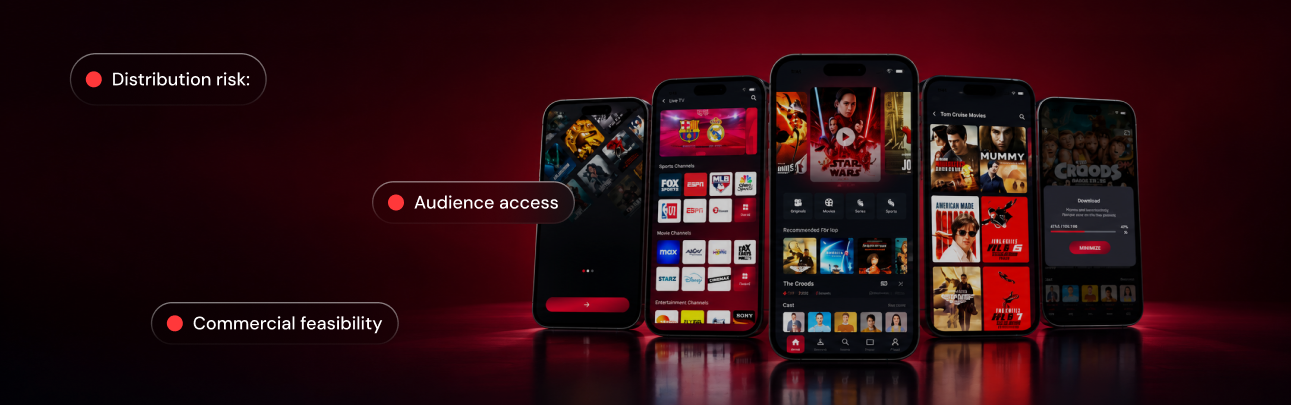
Use this three-part assessment:
Distribution risk: Which platforms account for the largest share of reach, viewing and revenue?
Audience access: Can the broadcaster lawfully build direct relationships with viewers and access useful performance data?
Commercial feasibility: Would an additional channel generate enough incremental value to justify content, technology, marketing and operating costs?
This assessment helps broadcasters identify where diversification may reduce business risk and where continued reliance on third-party distribution remains commercially sensible.
7 Steps to Reduce Dependence on Third-Party Streaming Platforms
Step 1: Identify Where Third-Party Platforms Create Business Risk
The problem: We may reach viewers without controlling the relationship
When we distribute content through external platforms such as netflix, youtube, we operate within their commercial agreements, monetisation policies, analytics tools and distribution systems. We may receive useful performance data without having the same direct access to viewers that we would have through our own registered audience.
The risk becomes more serious when one platform accounts for a large share of our viewing, advertising income or licensing revenue. A change in commercial terms, a loss of visibility, or the end of a licensing agreement could then affect a significant part of our business.
Why reduce this dependence?
We need to know which external relationships are helping us grow and which have become critical points of failure. Without that distinction, we might invest in an OTT service unnecessarily or discover too late that we have no alternative distribution route for important content.
Audience retention: Deloitte’s March 2026 Digital Media Monitor found that 41% of surveyed US consumers had cancelled at least one paid streaming subscription in the previous six months. This does not mean that third-party platforms are inherently less effective at retaining viewers, or that audiences will automatically stay with a broadcaster’s own OTT service.
It highlights a different business risk: viewers can stop paying when their needs, budgets or content preferences change. As broadcasters, we should therefore assess not only how much audience reach a third-party platform provides, but also whether we can lawfully reach viewers directly, understand repeat-viewing behaviour and offer alternative ways to access our content. Reducing dependence means diversifying our distribution and customer relationships, not assuming that an owned service will eliminate churn.
How to reduce the risk
Start with a distribution and revenue audit before investing in new technology.
Audience concentration: Measure how much viewing comes from each platform, including new and returning viewers.
Revenue concentration: Calculate the share of income generated by each distributor, advertising partner, licensing agreement,t and subscription channel.
Audience data: Identify which viewer information you can access and use lawfully, and whether you can communicate with viewers directly with their consent.
Content rights: Check which programmes you own or can distribute independently, including territorial restrictions, exclusivity and licensing windows.
Contractual exposure: Review termination clauses, payment terms, revenue shares, data access and any restrictions on distributing content elsewhere.
Operational dependencies: Record which suppliers control hosting, video delivery, billing, digital rights management (DRM) and analytics.
For example, if most of our digital video income comes from one platform, our first action may be to develop additional advertising relationships and test a direct viewing channel. If a distributor holds exclusive rights to our most valuable programmes, we must first understand when those rights expire and what restrictions apply.
Practical output: Create a dependency register that records each major risk, its financial or audience impact, the available alternative, and the next action required.
Step 2: Diversify Distribution Without Sacrificing Existing Reach
The problem: One distribution channel can become a single point of failure
Third-party platforms can introduce our programmes to audiences we might not reach through our own website or applications. However, depending on one major distributor or video platform means that our reach may be vulnerable to changes in its policies, commercial priorities,s or relationship with us.
Leaving these platforms completely can create the opposite problem: we lose discovery opportunities before our own channels have enough viewers to support the business.
Why reduce this dependence?
Our goal should be to build several routes to the audience, not replace one dependency with another. A diversified distribution strategy gives us more flexibility when negotiating licensing deals, promoting programmes and deciding where particular content should generate revenue.
How to reduce the risk
Assign each channel a defined business role.

For example, an Abu Dhabi sports broadcaster could publish rights-cleared match highlights on social platforms, offer schedules and editorial coverage on its website, and provide eligible replays, premium analysis or live events through its own branded streaming service.
The key is to give viewers a genuine reason to visit the direct channel. A link alone will not guarantee registrations or subscriptions.
Use campaign-specific links and landing pages to measure which channels generate registrations, repeat viewing, and paying customers. Before publishing content across multiple channels, confirm that the relevant rights permit it.
Practical output: Build a distribution plan that identifies the purpose, revenue potential, rights restrictions and performance measures for each channel.
Step 3: Build a Direct Monetisation Model Instead of Relying Only on Platform Payouts
The problem: We do not fully control the commercial terms of external distribution
When advertising revenue is generated through a third-party platform, our earnings depend on its monetisation rules, revenue-sharing arrangements, eligible views, and other applicable terms. Licensing agreements also determine how much we earn from distributing content through another service.
For example, YouTube states that eligible partners receive 55% of net revenue from watch-page advertisements under its applicable monetisation terms. This does not mean every broadcaster receives that rate or that the same terms apply to other platforms. It demonstrates why we need to understand the actual agreement behind each revenue stream.
Why reduce this dependence?
A direct revenue model gives us another way to earn from content and a greater ability to design commercial offers for our audience. It can also help us test whether a defined group of viewers is willing to pay for specialist programming, live events, exclusive content or an advertising-supported service.
However, direct monetisation is not automatically more profitable. We must account for customer acquisition, payment processing, content rights, hosting, delivery, support and retention.
How to reduce the risk
Choose the monetisation model according to the audience and content, not simply because a particular model is popular.

Digital video advertising is a significant commercial market. The Interactive Advertising Bureau reported that US digital video advertising expenditure reached $64 billion in 2024. This is evidence of the scale of the US market, not a forecast of UAE advertising revenue or a guarantee that a particular broadcaster will earn a profit.
Calculate break-even before investing.
Suppose a proposed direct streaming service has AED 50,000 in monthly fixed operating costs and earns AED 25 in monthly contribution per paying subscriber after variable costs.
The simplified break-even calculation is:
AED 50,000 ÷ AED 25 = 2,000 active paying subscribers.
This is an illustrative calculation, not an industry benchmark. It excludes any costs not included in the figures, such as initial investment or taxes, and assumes that contribution per subscriber remains stable.
For an advertising-supported service, calculate expected contribution using actual sellable advertising inventory, fill rates, net advertising revenue, viewing volume, and delivery costs.
Practical output: Prepare a financial model showing expected revenue, operating costs, acquisition costs, retention assumptions and break-even requirements before committing to a direct service.
Step 4: Launch a Branded OTT Service Without Replacing One Dependency With Another
The problem: Our distribution, audience data and technology may sit outside our control
A broadcaster that distributes all its content through external services may have limited control over its branded viewing experience, customer accounts and access to detailed audience data.
Launching an OTT service can address some of these limitations, but choosing a technology supplier without checking portability and commercial terms can create another form of lock-in. Owning an app does not automatically mean owning every part of the infrastructure or customer relationship.
Why reduce this dependence?
A branded OTT service can give us a direct destination for eligible content, a consistent viewing experience, and greater control over how we package and monetise programmes. It also creates a route for building registered audiences and measuring their engagement.
The investment only makes sense if the audience opportunity and business model justify the cost of operating the service.
How to reduce the risk
Start with the components required for the intended service and confirm that essential data and content records remain accessible.
1. Content management system (CMS)
Manage programmes, episodes, categories, metadata, subtitles, artwork and publishing schedules. Check that content metadata and associated assets can be exported in usable formats.
2. Rights and licensing management
Record ownership, territories, exclusivity, licensing periods and distribution windows. This helps prevent content from being published where the broadcaster does not hold the necessary rights.
3. Video hosting and content delivery network (CDN)
Choose an infrastructure model based on expected audience size, geographic reach, video quality, and peak concurrent viewing. Compare hosting, storage, delivery, redundancy and support costs instead of assuming that self-hosting is automatically cheaper.
4. Registration, accounts and billing
Make sure the business can access appropriate account, subscription and transaction records. Review payment-provider terms, cancellation processes and data portability.
5. Playback security and device support
Use digital rights management where required by content licences and supported devices. Technologies such as Widevine, FairPlay and PlayReady may be relevant, but the implementation should match the content rights and devices the audience actually uses.
6. Exportable analytics
Confirm that viewing activity, registrations, subscriptions, and revenue reports can be exported or integrated into systems the broadcaster controls.
Which OTT deployment model should we choose?
Managed streaming service: Reduces infrastructure administration, but the broadcaster should review recurring fees, data access, contractual restrictions and exit options.
Self-hosted white-label OTT platform: Can provide greater control over deployment, branding and software access, depending on the licence and architecture. The broadcaster remains responsible for, or must contract for, infrastructure, delivery, maintenance and security.
Custom-built streaming infrastructure: Offers architectural flexibility but usually requires more engineering, testing and ongoing operational resources.
A self-hosted white-label OTT platform can be suitable when we want a branded service and more control over deployment without developing every component from scratch. It does not remove dependence on cloud infrastructure, CDNs, payment providers, app stores or rights holders.
Practical output: Before selecting a supplier, document software ownership or licence rights, export options, recurring costs, infrastructure responsibilities, support arrangements and the process for migrating to another provider.
Step 5: Convert External Viewers Into a Direct Audience
The problem: Views do not necessarily create a customer relationship
A video may attract substantial views on a third-party platform without giving us a direct way to identify, reach, or retain those viewers. Public engagement figures can show that content is attracting attention, but they do not automatically tell us how many viewers would register, return, or pay for a service.
Why reduce this dependence?
A permission-based direct audience gives us a way to communicate with viewers through our own channels, understand their preferences and measure repeat engagement. It can support subscriptions, event sales, advertising and other commercial offers where there is genuine audience demand.
The aim is not to collect as much personal information as possible. It is to build a useful relationship with viewers who choose to engage with the broadcaster directly.
How to reduce the risk
1. Give viewers a clear reason to register.
Offer a genuine benefit, such as programme alerts, exclusive interviews, a specialist content library or access to a live event where rights permit.
2. Promote the direct service across existing channels.
Use television, radio, websites, newsletters, social media, event screens and relevant partner campaigns. During live broadcasts, QR codes can direct viewers to a programme page or registration form.
3. Keep registration simple.
Request only the information needed for the intended service. Explain how it will be used and obtain the necessary consent for communications and other processing.
4. Build a reason to return.
Publish regular programmes, new episodes, relevant live coverage and useful notifications. A single promotional campaign is unlikely to establish a lasting viewing habit on its own.
5. Measure the complete audience journey.
Track how many viewers reach the landing page, register, begin watching, return, and eventually subscribe or generate advertising revenue.
Do not assume that every social-media viewer will become a paying customer. Test which audience segments convert and whether the resulting revenue justifies the acquisition and operating costs.
For broadcasters operating in the UAE, audience-data collection and marketing must also follow applicable privacy and regulatory requirements.
Practical output: Build a measurable funnel from external discovery to direct registration, repeat viewing, and monetisation. Use the results to improve the offer rather than relying on view counts alone.
Step 6: Own Your Performance Data and Reduce Technology Lock-In
The problem: We may depend on separate dashboards and suppliers to understand our business
External platforms and technology vendors can provide useful analytics, but their reports may use different definitions, cover different periods, or restrict how information can be exported. This can make it difficult to compare commercial performance across channels.
Technology lock-in creates a related risk: if essential content records, customer data or operational workflows cannot be transferred easily, changing suppliers may become expensive or disruptive.
Why reduce this dependence?
We need a consistent view of audience behaviour, revenue and operating costs to decide where to invest. We also need to know whether we can continue delivering content if a critical supplier becomes unavailable or the commercial relationship changes.
Reducing lock-in does not mean eliminating every supplier. It means having enough visibility, portability and contingency planning to make informed decisions.
How to reduce the risk
Use a consistent measurement framework across third-party distribution and the broadcaster's direct service.
Metric | What it helps us understand |
Revenue concentration | How much income depends on each distributor or commercial partner |
Direct registered viewers | The size of the permission-based audience relationship |
Registration-to-view conversion | Whether acquisition campaigns bring in people who actually watch |
Repeat viewing and retention | Whether audiences return over time |
Subscriber churn | How frequently paying customers cancel |
Customer acquisition cost | How much it costs to acquire a direct customer |
Contribution margin | How much revenue remains after relevant variable costs |
Revenue per viewing hour | How effectively viewing generates commercial value |
Data and content portability | Whether essential records can be exported and moved to another provider |
Define consistent event names and reporting rules. Test data exports before committing to a supplier, and reconcile viewing activity, subscriptions and revenue as far as the available data permits.
For live broadcasts, test delivery capacity, monitoring, backup procedures and recovery plans before high-value events. Where the cost of failure justifies it, identify alternative suppliers for critical services.
Practical output: Maintain a performance dashboard, schedule regular export tests and document contingency plans for critical technology and distribution relationships.
Step 7: Apply the Strategy to the UAE and Abu Dhabi Market
The problem: A strategy that works elsewhere may not fit our rights, audience, or regulatory obligations
Broadcasters operating in the UAE must consider more than the technical ability to stream content. The commercial opportunity depends on the audience, content rights, revenue model, operating costs and applicable media requirements.
A sports broadcaster, for example, may have strong audience interest but limited rights to distribute particular matches directly. A production company may own some titles outright while other content remains licensed to third parties. These differences determine which forms of independence are realistic.
Why reduce this dependence?
A locally relevant distribution strategy helps us expand direct access to audiences without overlooking existing licensing relationships or regulatory obligations. It also prevents us from investing in a service before confirming that the content can legally and commercially be distributed through it.
The UAE Government's media-regulation guidance identifies television broadcasting and digital or electronic media activities among the activities covered by the country's media regulatory framework. Requirements depend on the nature of the activity and the relevant authority, so broadcasters should confirm the rules that apply to their particular operation.
How to reduce the risk in practice
For a television broadcaster: Audit licensing agreements, identify programmes available for direct distribution and test a branded digital destination with a defined audience.
For a sports broadcaster: Confirm event rights, geographic restrictions, peak concurrent viewing requirements and the economics of subscriptions, sponsorship or pay-per-view.
For an educational or specialist content owner: Test demand among a defined audience before investing in a large library or a costly multi-device rollout.
For a production company: Separate titles owned outright from titles already licensed, then evaluate whether a direct library or niche streaming service can generate additional revenue.
For an established media group: Assess revenue concentration, data access, rights availability, and the operating cost of expanding direct distribution.
Before launching or expanding an OTT service, confirm applicable media licensing, content, advertising, privacy, and other regulatory requirements for the business and its operating jurisdiction.
Practical output: Develop a UAE-specific plan that starts with the content rights we control, the audience we can realistically reach, and the commercial model we can validate.
A Practical 90-Day Starting Plan
Reducing dependence on third-party streaming platforms is a business transition, not simply an app-development project. Broadcasters can use the first 90 days to assess their risks, validate demand for direct distribution, and test a practical alternative.
Days 1–30: Audit audience, revenue and supplier dependencies
Map audience and revenue concentration, review contracts and content rights, and assess access to viewer data and reliance on external suppliers. The goal is to create a dependency register that identifies the most significant risks and prioritises what needs attention first.
Days 31–60: Validate the direct-distribution opportunity
Choose a specific audience segment, test a direct content offer, estimate potential monetisation and compare suitable technology options. Use audience feedback, projected costs and supplier evaluations to determine whether a direct channel is commercially and operationally viable.
Days 61–90: Run a focused pilot
Where the business case supports it, launch or improve a limited direct channel and promote it through existing distribution and marketing channels. Measure registrations, repeat viewing, conversion rates, and operating costs to understand what works and what needs to change before expanding.
The timeline will depend on content rights, technical readiness, budget, and internal approvals. A 90-day plan is intended to validate the next step, not guarantee that a full OTT service will become profitable within three months.
Conclusion
Third-party streaming platforms can help broadcasters distribute content and reach new audiences, but relying on them too heavily can limit control over distribution, monetisation, customer relationships and technology choices.
The practical response is to diversify distribution, understand content rights, validate direct revenue models, build permission-based audience relationships and choose technology with clear portability and exit options. For broadcasters in Abu Dhabi and the wider UAE, these decisions should reflect the actual content rights, audience demand, operating economics and regulatory requirements of the business.
The objective is not to eliminate every third-party relationship. It is to ensure that no single platform or supplier has more control over our audience, revenue or operations than our business can reasonably afford.


