

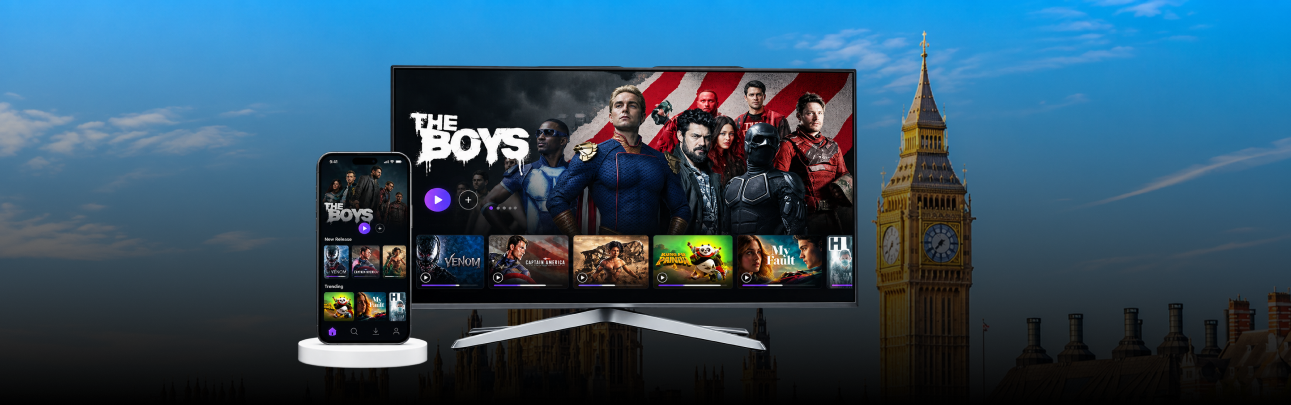
OTT (over-the-top) app development is the process of building a video, audio, or live-streaming application that delivers content directly over the internet, bypassing traditional broadcast or cable providers. In the UK, successful OTT apps in 2026 require GDPR-compliant data handling, multi-device support, and payment flexibility that accounts for subscription fatigue among British consumers. Costs typically range from £30,000 for a basic OTT to £250,000+ for a full-featured platform with live streaming and personalization.
The UK streaming market has matured past the point where launching an app with a video player and a subscription button is enough to compete. BBC iPlayer, ITVX, and Channel 4's streaming service have set audience expectations around personalization, accessibility, and content discovery that any new entrant now has to match. Building an OTT app in the UK in 2026 means designing for a specific regulatory environment, a specific set of viewing habits, and a specific level of competition that didn't exist five years ago.
This guide walks through what UK businesses need to plan for before writing a single line of code: features, costs, compliance, and the platform decisions that determine whether an OTT app succeeds or quietly disappears from app stores within a year.
Quick answer: OTT App Development in the UK
OTT app development in the UK typically costs around £30,000–£250,000+ for custom builds, while complex enterprise platforms can exceed £450,000. The UK market remains active, with 78% of consumers having access to paid video services and an average 2of .86 video subscriptions per household.
The right approach depends on whether you need custom development or a white-label OTT platform. UK-focused custom options include iCode49, FX Digital and 2Base Technologies, while white-label choices include Vodlix, Regal Streaming Solutions and Castr. UK projects should also account for Ofcom accessibility requirements, UK GDPR, DRM, multi-device delivery, monetization, hosting and ongoing infrastructure costs.
How Much Does OTT App Development Cost in the UK?
There is no single UK price for an OTT platform because custom development and white-label OTT use completely different cost models.
For a serious multi-platform OTT product, current 2026 industry benchmarks put custom development at roughly £45,000–£375,000+, with more complex enterprise platforms potentially reaching £450,000+. GoodFirms currently estimates $60,000–$500,000+ for OTT development, while Appinventiv puts custom OTT development at $60,000–$600,000+. These are global development benchmarks, not a claimed UK market average.
Custom OTT development: roughly £45,000–£375,000+
Custom OTT platform Cost, your budget usually covers much more than the viewer app:
UI/UX design
iOS and Android apps
Web application
Smart TV/connected-TV apps
CMS and backend
Video streaming integration
Payments and subscriptions
Analytics
DRM and security
Testing and deployment
GoodFirms' September 2026 breakdown estimates $40,000–$90,000 (£30,000–£67,000) for a niche single-platform MVP and $80,000–$250,000+ (£60,000–£187,000+) for a more complex multi-platform OTT application. Its broader benchmark reaches $500,000+ for highly complex platforms.
The infrastructure is another cost layer. GoodFirms estimates around $20,000–$60,000 for backend and streaming infrastructure during development, while testing and QA can add another $5,000–$15,000.
So if someone quotes £10,000 for an “OTT app”, check exactly what is included. It may be a mobile application rather than the complete OTT platform.
White-label SaaS OTT: roughly £250–£3,000+ per month
SaaS white-label platforms reduce the upfront development requirement because the provider already operates the underlying OTT technology.
For example, Muvi's current video OTT pricing starts at $399/month (about £299), with its Professional plan at $1,499/month (about £1,122) and Enterprise at $3,900/month (about £2,920), before any applicable variable fees. Its plans include features such as a white-label website, mobile/TV apps, CMS, streaming, monetization, and DRM depending on the tier.
Vimeo OTT uses a different model: its Starter plan has no upfront platform subscription, but charges $1 (£0.75) per subscriber per month, plus 10% of one-time purchases and payment-processing fees. Branded apps and some advanced functionality are available through Enterprise.
That means a SaaS platform can look inexpensive at launch but become a high recurring operating cost as subscribers and requirements increase.
Self-hosted white-label OTT: higher upfront cost, different ongoing cost
Self-hosted vs saas based platform , A self-hosted white-label OTT solution sits between building everything from scratch and renting a SaaS platform.
With Regal Streaming Solutions, for example, the platform is positioned as a self-hosted white-label OTT product rather than a conventional SaaS subscription. The software can be deployed on the client's own cloud infrastructure, with source-code/platform ownership and control over the underlying environment.
The important cost difference is that you are not replacing the software cost with “zero cost”. You are replacing a recurring SaaS platform fee with your own infrastructure costs.
A typical self-hosted setup can include:

For example, AWS CloudFront currently provides 1 TB of data transfer out per month free, after which European delivery starts at around $0.085/GB for the first 10 TB under its standard pricing structure. AWS also confirms that transfer from AWS origins such as S3 or EC2 to CloudFront is not separately charged.
That means CDN cost is driven primarily by how much video your viewers actually watch.
For example, 10 TB of monthly UK/European CDN delivery at the first-tier rate would be roughly $850/month, or about £636, before other AWS services and applicable charges.
What should you budget each month after launch?
For a self-hosted OTT platform, there is no honest universal monthly figure because viewing hours determine the highest variable cost.
As a practical planning model, budget separately for:
Cloud + database: depends on architecture and traffic.
Storage: depends on the size of your content library and backups.
CDN: depends heavily on monthly viewing hours and average video bitrate.
Transcoding: depends on how much new content you process.
Maintenance: commonly budgeted as an ongoing engineering/support cost rather than treating development as finished at launch. One 2026 OTT development benchmark puts maintenance at around 10–20% of the initial development cost annually, although the actual requirement depends on how much support and feature development you outsource.
The practical lesson is simple:
Custom OTT = larger upfront engineering investment + ongoing technology costs.
SaaS white-label = lower upfront investment + recurring platform/usage fees.
Self-hosted white-label = upfront platform investment + infrastructure and maintenance costs you control directly.
If you are comparing providers, don't compare only the launch price. Calculate the three-year total cost using your expected subscribers, viewing hours, content volume, and number of apps.
That is where the real difference between a SaaS OTT platform and a self-hosted white-label platform becomes visible.
What Does an OTT App Development Project Include?
Viewer apps:
The customer-facing OTT experience across Web, iOS, Android, Android TV, Fire TV and other supported connected-TV platforms.
OTT backend:
The technology that manages users, subscriptions, payments, content, access permissions, viewing data and business operations.
CMS:
The administration system used to upload, organise, schedule and manage movies, series, episodes, live channels, metadata and artwork without changing the app.
Video infrastructure:
The streaming layer responsible for video storage, encoding or transcoding, adaptive bitrate delivery, playback and CDN distribution.
Monetization:
The systems required for SVOD subscriptions, AVOD advertising, TVOD or PPV purchases, trials, coupons and payment processing.
Content protection:
Authentication, playback restrictions and DRM such as Widevine, FairPlay or PlayReady can protect premium content from unauthorised access.
Analytics:
Viewer, content, subscription and revenue data that helps operators understand what audiences watch and how the service performs.
Live streaming:
Live OTT services may additionally require live encoding, channel management, scheduling, real-time monitoring, DVR/catch-up and scalable live delivery.
Accessibility:
Subtitles, captions, audio-description support and accessible navigation may be required depending on the service, audience and applicable UK requirements.
Technical support:
OTT development does not end at app launch. Operating-system updates, app-store changes, security updates, infrastructure monitoring and ongoing maintenance need to be planned from the beginning.
The important distinction:
An “OTT app” can mean only the viewer-facing application, while an “OTT platform” normally includes the apps plus the CMS, backend, video infrastructure, monetization, analytics, and security required to operate the streaming business.
How Does OTT App Development Work?
1. Define the OTT business model:
Start by identifying the content, target audience, geographic market, and how the service will make money. This determines the platform features, infrastructure,e and payment requirements.
2. Choose the monetization model:
Decide whether the service will use SVOD (subscription video on demand), AVOD (advertising-supported video on demand), TVOD (transactional video on demand), PPV pay-per-view), or a hybrid OTT monetization model. The choice affects subscriptions, payments, advertising, and access-control requirements.
3. Define the platform scope:
Decide where customers need to watch the service, such as Web, iOS, Android, Android TV, Fire TV, Apple TV, Roku, Samsung, or LG Smart TV. Each additional platform can add development, testing, and maintenance requirements.
4. Design the OTT product:
Map the viewer journey from registration and content discovery to playback, subscription, and payment. At the same time, design the OTT CMS and admin workflows used to upload content, manage users, schedule releases, and monitor the service.
5. Build or configure the OTT technology:
Develop or configure the backend, CMS, video streaming infrastructure, CDN, payments, subscriptions, analytics, cs and content protection. For premium services, DRM such as Widevine, FairPlay,y or PlayReady may also be required.
6. Test streaming across devices:
Test playback, adaptive bitrate switching, authentication, payments, subtitles, downloads, and app performance across supported devices and network conditions. OTT testing needs to account for differences between mobile, web, and connected-TV environments.
7. Deploy the OTT service:
Publish the applications through the relevant app stores and connected-TV platforms, configure production infrastructure, and connect the final content catalogue, payments, analytics, and security systems.
8. Operate and improve the platform:
OTT development continues after launch. Ongoing work can include app updates, operating-system compatibility, cloud and CDN monitoring, security updates, content operations, analytics, bug fixes and new feature development.
How Long Does It Take to Build an OTT App?
Timelines depend on scope, but here are typical estimates:
White-label setup: a few weeks to around two months (Regal builds it in 45 days).
Mid-range custom build: roughly 3–6 months.
Complex multi-platform build: 6–12 months or more.
Factors that extend timelines include the number of devices, custom features, third-party integrations, and rigorous compliance or DRM requirements. App store review times can also add days to weeks near launch.
If speed matters most, a white-label route gets you to market fastest. If differentiation matters most, plan for a longer custom build.
Custom OTT Development vs White-Label OTT
Custom OTT development:
A custom OTT platform is built specifically around your business requirements. It is suitable when you need proprietary features, unique viewer journeys, complex integrations, custom monetization rules, or technology that an existing OTT platform cannot provide. The trade-off is a higher upfront development cost, longer development cycle, and greater responsibility for ongoing maintenance.
White-label OTT platform:
A white-label OTT platform provides an existing streaming technology foundation that can be branded and configured for your business. Instead of developing the complete OTT infrastructure from scratch, you can use an existing CMS, backend, video streaming architecture, and applications, depending on the provider. This can reduce development time and simplify multi-platform OTT deployment.
SaaS white-label OTT:
A SaaS OTT platform is operated by the provider, usually with a recurring monthly or annual subscription. The provider typically manages the core platform infrastructure, while you operate your branded streaming service. Before choosing this model, check subscriber-based fees, platform fees, hosting limits, transaction charges,s and what happens to your data if you leave.
Self-hosted white-label OTT:
A self-hosted white-label platform gives the business greater control over where the OTT technology is deployed. For example, Regal Streaming Solutions provides a self-hosted white-label OTT model where the platform can be deployed on the client's own cloud infrastructure rather than requiring a mandatory SaaS platform subscription. The business should still budget separately for cloud hosting, CDN, storage, transcoding, D, RM and ongoing technical maintenance.
Which model should you choose?:
Custom development gives you greater control over the product architecture but requires more engineering investment. White-label OTT can provide a faster route to launching an established OTT feature set. The right choice depends on your required customisation, launch timeline, technology ownership, infrastructure control, and long-term operating costs.
What to check before choosing a provider:
Ask who owns the source code, where the platform is hosted, which apps are included, what can be customised, whether DRM is supported, what recurring fees apply, who pays infrastructure costs, how data can be exported, and whether you can migrate the platform later.
Top OTT App Development Companies in the UK 2026
If you are looking for a custom OTT app development company in the UK, compare providers on actual OTT experience rather than their general mobile-app portfolio. The important capabilities are connected-TV development, VOD and live streaming, CMS/backend engineering, DRM, video infrastructure, app-store certification and post-launch support.
GoodFirms' OTT directory, updated in September 2026, has reviewed 374 OTT app development companies across 36 countries. It reports a median OTT development rate of $37/hour, while its UK-specific data shows six OTT firms with an average hourly rate of about $44/hour. GoodFirms says its OTT listings are evaluated using factors including client reviews, portfolio depth, service expertise, and market presence.
For a UK project, these three companies are worth considering because each brings a different type of custom OTT development experience.
1. iCode49 Technolabs
Why consider it:
iCode49 Technolabs develops custom OTT platforms and multi-platform OTT applications through its Custom OTT platform development solutions. Its published OTT offering covers Web, Android, iOS and Smart TV apps, video CMS workflows, live streaming architecture, DRM, cloud infrastructure and CDN optimisation.
Its portfolio also documents OTT products including Binge Marathi, Brio and Drama Tashan, while iCode49 states that it has delivered an OTT platform for Binge Marathi.
Best fit: Businesses looking for a development partner that can build the OTT platform, applications and supporting technology rather than only a single mobile app.
2. FX Digital
Why consider it:
FX Digital is a London-based Connected TV-first OTT development company. Its published services cover Smart TVs, set-top boxes and gaming consoles, alongside product design, engineering and specialist CTV quality assurance. Its current site also documents work involving Discovery+, Eurosport Player and other streaming products.
Clutch lists FX Digital as a London company founded in 2011, with a $25,000+ minimum project size and a focus that includes custom software, web development, and application testing.
Best fit:
Businesses where connected-TV applications and cross-device streaming experience are a major part of the OTT product.
3. 2Base Technologies
Why consider it:
2Base Technologies is a custom software and product-engineering company with a London office and 16+ years of development experience. GoodFirms includes it in its September 2026 OTT development directory, where it is listed as a London-based provider with a $50–$99/hour rate range.
Its broader engineering services cover custom software, mobile and web applications, cloud, Q, A and digital product engineering, making it relevant when an OTT project requires a broader bespoke technology stack rather than a ready-made platform.
Best fit:
Businesses that need bespoke software engineering around an OTT product, particularly where the streaming platform also needs wider enterprise or custom-system integrations.
Top White-Label OTT Platforms in 2026 for UK Businesses
A white-label OTT platform gives a business the technology to launch a branded streaming service without developing every OTT component from scratch. But not every white-label platform uses the same deployment model. Some are SaaS-based and provider-hosted, while others can be self-hosted, giving the business more control over infrastructure and technology ownership.
For a UK business, compare the hosting model, source-code ownership, supported apps, monetization, DRM, recurring fees, and migration options rather than comparing feature counts alone.
1. Vodlix
Vodlix: A SaaS-oriented white-label OTT platform operated by Fast OTT Ltd, which lists its office in London. Vodlix provides branded OTT services across web, mobile,e and TV, with support for VOD, live streaming, and monetization models including SVOD, TVOD, and AVOD. Its current pricing also includes a Pay as You Grow model charging $0.99 per active subscriber per month, making its recurring cost structure important to evaluate at scale.
Best suited for: Businesses looking for a managed white-label OTT service where the provider operates the underlying platform rather than the client managing the complete infrastructure themselves.
2. Regal Streaming Solutions
Regal Streaming Solutions: A self-hosted white-label OTT platform from iCode49 Technolabs. Unlike a conventional SaaS OTT service, Regal's published model focuses on platform and source-code ownership, deployment on the client's infrastructure, and control over the branded OTT business. It supports OTT applications, VOD, live streaming,g and monetization models including SVOD, AVOD, TVOD, OD, and PPV.
Best suited for: Businesses that want a branded OTT platform while retaining greater control over source code, hosting, data, customisation and infrastructure, rather than depending on a mandatory recurring SaaS platform subscription.
3. Castr
Castr: A provider-hosted white-label OTT platform designed for media companies, broadcasters, sports rights holders and content owners. Its current offering supports branded web, iOS, Android,d and connected-TV applications including Roku, Apple TV, Android TV, Fire TV, Samsung Tizen, O S and LG webOS. It supports SVOD, TVOD, and ad-supported monetization, with native mobile and TV apps separately scoped from its branded web service.
Best suited for: Content businesses that want the provider to handle video hosting, branded applications, checkout, and OTT operations rather than managing their own OTT infrastructure.
SaaS vs self-hosted white-label OTT
SaaS white-label: The provider operates the OTT platform and infrastructure, and you generally pay a recurring platform fee, subscriber fee, commission,n or combination of these.
Self-hosted white-label: The OTT software is deployed on infrastructure controlled by the client. You have greater control over hosting, data, ta and platform operations, but you remain responsible for infrastructure costs such as cloud hosting, storage, and CDN.
The important question: Do not assume that “white-label” means source-code ownership or infrastructure control. Before signing, confirm who owns the software, where it is hosted, what recurring fees apply, what is included in the licence, and whether you can migrate the service later.
How to Choose an OTT Development Company or Platform
Choosing an OTT development company is not only about comparing development prices. Check technology ownership, deployment, platform coverage, streaming infrastructure, and long-term operating costs before signing.
Who owns the source code? Confirm whether the source code and intellectual property belong to you, the development company, or the OTT platform provider. A “white-label” label alone does not mean you receive source-code ownership.
Where will the OTT platform be hosted? Confirm whether the CMS, backend, database, and applications run on your AWS, Azure,e or other cloud account, the provider's infrastructure,e or a third-party environment. This directly affects control, security, migration, and recurring infrastructure costs.
Can I migrate the platform later? Ask how your content, customer data, subscriptions, analytics, and other business data can be exported if you change providers. A documented OTT migration and exit process is safer than relying on a verbal assurance.
Which OTT platforms are included? Ask for the exact supported platforms rather than accepting “multi-platform” as an answer. Check whether the proposal includes Web, iOS, Android, Android TV, Fire TV, Apple TV, Roku, Samsung Tizen, en and LG webOS, and whether each application is included in the quoted price.
Does the platform support VOD and live streaming? Confirm whether the technology supports your actual streaming model. VOD, live channels, and large live events can require different encoding, delivery, monitoring,g and infrastructure requirements.
Does DRM include: If you distribute premium or licensed video, confirm which Digital Rights Management (DRM) technologies are supported, such as Google Widevine, Apple FairPlay, and Microsoft PlayReady, and whether DRM licensing is included or charged separately.
How does monetization work? Confirm support for the business model you intend to use—SVOD, AVOD, TVOD, PPV, or hybrid monetization—and check payment-gateway fees, transaction charges, subscription management,t and revenue-sharing terms.
What are the recurring OTT costs? Separate the initial development or platform fee from cloud hosting, CDN, video storage, transcoding, DRM, app maintenance, support, platform subscriptions,s and payment-processing fees. A low upfront price can become expensive if recurring usage fees are high.
Who handles app-store and connected-TV certification: Ask whether the provider manages submission, testing, and certification for Apple App Store, Google Play,y and connected-TV platforms. TV applications can have separate technical and certification requirements.
What happens after launch: Confirm who handles operating-system updates, security patches, application bugs, infrastructure monitoring, and new device compatibility. OTT development is an ongoing product operation, not a project that necessarily ends when the apps reach the app stores.
Can I customise the platform? Ask which parts can be changed without custom development. This includes the UI/UX, CMS workflows, subscription rules, payment integrations, analytics, APIs, branding,g and third-party integrations.
Can the platform scale with my audience? Ask how the provider handles traffic spikes, concurrent streams, CDN capacity, database scaling,g and live-event demand. A platform that works for a few thousand viewers may require a different infrastructure strategy when concurrent viewing increases.
What should you compare: Compare the total cost of ownership, technology ownership, hosting model, platform coverage, customisation, streaming capabilities, security, scalability and post-launch support—not just the initial development quotation.
UK-Specific OTT Considerations
UK OTT regulation: An OTT app serving UK audiences may need to account for Ofcom rules, accessibility requirements and UK data protection obligations during development. These requirements depend on the type and scale of the service, so they should be assessed before launch rather than added after the product is built.
Ofcom compliance: Ofcom regulates editorial content on UK on-demand programme services (ODPS). Where a service falls within the ODPS framework, the provider must notify Ofcom before the service begins and comply with applicable administrative and content requirements. Ofcom’s ODPS rules and guidance were updated in 2025 to reflect changes introduced by the Media Act 2024.
Streaming accessibility: The Media Act 2024 introduced new accessibility requirements for larger on-demand services classified as Tier 1 Services. In 2026, Ofcom consulted on a new Tier 1 Accessibility Code covering measures such as subtitling, audio description and signing, as well as requirements around informing users about accessibility features and reporting on their quality and usability. The consultation closed in August 2026, and the final statement is pending.
Privacy by design: UK OTT development should treat data protection as an architecture requirement, not simply a privacy-policy task. The ICO's guidance, updated in February 2026, says organisations should integrate data protection into products and services from the design stage and throughout their lifecycle.
OTT user data: This is particularly relevant when an app collects account information, viewing history, analytics, personalised recommendations, advertising data, cookies or children's data. The technical design should consider data minimisation, access controls, security, retention and user rights from the beginning. Where processing is likely to create high risks to people's rights, the ICO recommends carrying out a Data Protection Impact Assessment (DPIA).
Children's data: If the OTT service is likely to be accessed by children, the architecture and product experience need additional consideration. The ICO's 2026 guidance specifically highlights children's higher protection matters when organisations design technical and organisational measures for online services.
What this means for development: A UK OTT project should therefore cover Ofcom applicability, accessibility, privacy, data governance and security during requirements and architecture planning. The exact obligations should be assessed against the service's content, audience, business model and scale rather than assuming every OTT app has identical UK regulatory requirements.
Is There Still Demand for OTT Services in the UK?
Yes, but the opportunity is no longer simply “people are moving from television to streaming”.
The UK market is already mature.
Deloitte's 2026 UK Digital Consumer Trends research found that 78% of consumers had access to paid video platforms, up from 73% in 2023. It also found an average of 2.86 TV and film subscriptions per household.
That changes the product challenge.
A new OTT service needs a reason for someone to subscribe, return and remain subscribed. For niche content businesses, sports organisations, broadcasters, publishers and creators, that can mean building around exclusive content, a specific audience or a differentiated viewing experience, rather than trying to become another general entertainment service.
Conclusion
OTT app development in the UK requires more than building a video streaming app: you need the right combination of OTT technology, viewer apps, CMS, VOD and live streaming, monetization, CDN, DRM, analytics, accessibility and UK-specific compliance. The main decision is whether to build a custom OTT platform, use a SaaS white-label OTT platform, or deploy a self-hosted white-label OTT solution based on your required control, customization, budget, and ongoing operating model.
Before choosing an OTT development company or platform, compare source-code ownership, hosting, supported devices, scalability, DRM, monetization, app-store/connected-TV support, recurring costs,s and post-launch support. For UK businesses, planning these requirements before development can reduce technical changes later and create a more scalable OTT product for Web, iOS, Android and connected TV.
Frequently Asked Questions
Yes. You can launch using a third-party OTT platform, but the important distinction is whether it is SaaS or self-hosted. SaaS platforms typically keep the core technology under the provider's control, while self-hosted solutions can give the business greater control over its deployment and platform.
Not necessarily. “OTT app” can refer to a single viewer application or the wider OTT product. If you want to reach UK viewers across web, mobile and connected TVs, confirm exactly which platforms, apps and backend systems are included in the development scope.
The difference usually comes from scope rather than the name of the app. A quote may cover only one mobile app, while another includes CMS, backend, live streaming, DRM, multiple TV platforms, subscriptions, analytics, payment integration,n and infrastructure.
It depends on what you own and what the provider allows you to export. Before signing, check whether you can migrate your content, subscriber data, metadata, analytics, and application assets, and whether the platform uses proprietary technology that could make migration difficult.
Usually, different device ecosystems require different application builds or platform-specific implementations. A UK OTT project may therefore involve iOS, Android, web, Android TV, Fire TV and Smart TV platforms rather than treating “one OTT app” as a single application.
Yes, a web-based OTT experience can be launched without native mobile or TV apps. However, if your audience watches primarily through mobile devices or connected TVs, native apps may provide capabilities and distribution options that a responsive website does not.


