

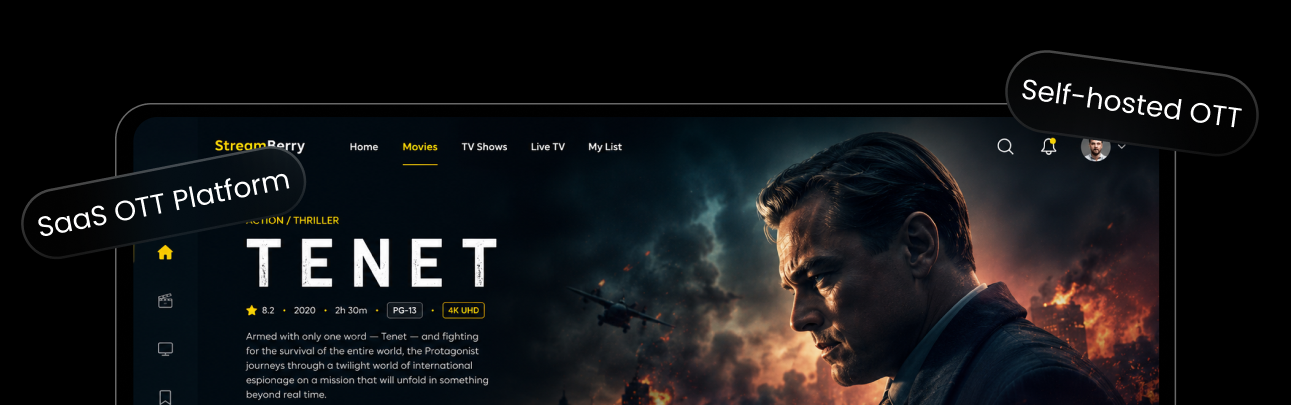
Choosing the wrong OTT infrastructure can slow growth, increase costs, and create major scaling problems later. That is why businesses planning to launch a streaming platform often compare SaaS white-label OTT platforms and self-hosted white-label OTT platforms before investing.
The real question is not which model is technically better. It is the one that fits your business stage, budget, customization needs, and long-term growth strategy.
This article explains the real difference between SaaS white-label OTT platforms and self-hosted white label OTT platforms, including costs, scalability, ownership, customization, security, and monetization, so you can choose the right white-label OTT platform to build and grow your own OTT business in 2026.
What is the difference between SaaS and a self-hosted white-label OTT Platform?
Factor | SaaS White-Label OTT Platform | Self-Hosted White-Label OTT Platform |
Infrastructure Ownership | Managed by the provider | Fully owned and controlled by the business |
Launch Speed | Fast deployment, often within weeks | Longer deployment due to custom setup |
Initial Cost | Lower upfront investment | Higher upfront investment |
Technical Complexity | Minimal technical expertise required | Requires engineering and DevOps resources |
Maintenance Responsibility | Managed by the provider | Managed internally |
Customization Flexibility | Moderate customization options | Extensive customization capabilities |
Scalability Control | Provider-managed scaling | Full control over scaling strategy |
Monetization Flexibility | Limited by platform capabilities | Fully customizable monetization models |
Security & DRM Control | Built-in and provider-managed | Fully customizable but self-managed |
Vendor Lock-In Risk | Higher dependency on the provider ecosystem | Lower dependency and greater flexibility |
Time to Market | Faster go-to-market | Longer development timeline |
Best For | Startups, creators, educators, agencies, and growing OTT businesses | Enterprises, broadcasters, sports platforms, and large-scale OTT operations |
Regal’s OTT Expert Recommendation:
For most startups, creators, educators, and niche OTT businesses, a SaaS white-label OTT platform is the most practical choice because it reduces infrastructure complexity and shortens time to market.
Self-hosted OTT platforms become more valuable when customization, infrastructure ownership, and large-scale streaming operations directly impact business growth.
What Is a SaaS White-Label OTT Platform?
A SaaS white-label OTT platform is a managed streaming solution that allows businesses to launch their own branded OTT service without building the entire video infrastructure from scratch.
In this model, the OTT provider manages the technical backend, including hosting, streaming infrastructure, maintenance, updates, security, and video delivery, while the business focuses on content, audience growth, and monetization.
Instead of developing a custom streaming architecture internally, businesses pay a recurring subscription or platform fee to use an existing OTT ecosystem with white-label branding capabilities.
Providers like Vimeo, Brightcove, and similar white-label OTT vendors typically operate using this SaaS-based model.
How Does a White-Label SaaS OTT Platform Work?
A white-label SaaS OTT platform provides a ready-made streaming infrastructure that businesses can customize with their own branding, content, apps, and monetization model. Instead of building the entire OTT architecture from scratch, businesses use a managed OTT ecosystem operated by the provider.
Video Hosting & Cloud Storage
The platform stores and manages video content securely in the cloud, making it accessible across web, mobile, and Smart TV devices.
Video Encoding & Transcoding
Uploaded videos are automatically converted into multiple resolutions and formats for smooth streaming across different internet speeds and devices.
CDN-Based Content Delivery
Content Delivery Networks (CDNs) distribute video streams globally to reduce buffering, improve playback speed, and support high traffic loads.
OTT CMS & Content Management
The built-in OTT CMS helps businesses upload, organize, schedule, and manage movies, series, live streams, and video libraries from a centralized dashboard.
User Authentication & Access Control
The platform manages user login systems, subscription access, profile management, and secure viewer authentication.
Subscription Billing & Payment Systems
Most SaaS OTT platforms include integrated payment gateways for subscriptions, memberships, pay-per-view, and recurring billing models.
Analytics & Audience Tracking
Businesses can monitor watch time, engagement, subscriber growth, retention, revenue performance, and user behavior through analytics dashboards.
Mobile & Smart TV App Deployment
The provider often manages deployment and maintenance for OTT apps across Android, iOS, Apple TV, Android TV, Roku, Fire TV, and Smart TVs.
Platform Maintenance & Security Updates
The OTT vendor handles backend maintenance, server monitoring, bug fixes, software updates, and infrastructure optimization.
DRM & Content Protection
Digital Rights Management (DRM), stream encryption, and secure playback technologies help protect premium content from piracy and unauthorized sharing.
Because the technical infrastructure is managed externally, businesses can focus more on: Content production, Brand growth, Audience acquisition, Subscriber retention, OTT monetization strategies That operational simplicity is one of the biggest reasons SaaS OTT platforms are widely used by startups, creators, educators, fitness brands, media companies, and niche streaming businesses looking for faster go-to-market execution.
What Is a White-Label Self-Hosted OTT Platform?
A white-label self-hosted OTT platform is a custom streaming infrastructure where the business owns and manages the backend architecture, video delivery systems, applications, and platform operations instead of relying entirely on a third-party SaaS provider.
In this model, businesses launch a fully branded OTT platform while maintaining greater control over infrastructure, customization, scalability, security, and monetization workflows.
Unlike SaaS OTT platforms, where the provider manages most technical operations, a self-hosted OTT setup gives businesses ownership over the streaming ecosystem itself.
This approach is commonly used by large media companies, broadcasters, enterprise streaming businesses, sports platforms, and OTT brands that require advanced customization, infrastructure flexibility, and long-term operational independence.
Many self-hosted OTT platforms are deployed using cloud infrastructure providers such as Amazon Web Services, Google Cloud, and Cloudflare.
How Does a White-Label Self-Hosted OTT Platform Work?
A self-hosted OTT platform works by allowing businesses to build, manage, and optimize their own streaming infrastructure instead of depending entirely on a managed OTT ecosystem.
This setup provides greater architectural control but also requires stronger technical management capabilities.
Cloud Storage Infrastructure
Video files, media assets, backups, and streaming content are hosted within dedicated cloud storage environments controlled by the business.
Video Encoding & Transcoding Pipelines
Self-hosted OTT systems require custom transcoding workflows that convert videos into multiple formats and resolutions for adaptive streaming across devices and internet speeds.
CDN Configuration & Video Delivery
Businesses configure their own CDN architecture to optimize global content delivery, playback speed, buffering performance, and live streaming scalability.
API Infrastructure & Backend Systems
Custom APIs are often developed to support OTT workflows such as subscriptions, user management, analytics, recommendations, and third-party integrations.
DRM & Content Protection
Self-hosted OTT platforms usually integrate DRM technologies, stream encryption, watermarking, and secure playback systems to protect premium video content from piracy.
User Authentication & Access Management
The platform manages subscriber accounts, login systems, profile permissions, secure access controls, and subscription authentication internally.
Monitoring & Performance Optimization
Businesses use infrastructure monitoring tools to track server health, streaming performance, traffic spikes, playback errors, and platform uptime.
DevOps & Infrastructure Management
Dedicated DevOps workflows are needed to maintain servers, deploy updates, optimize scaling, manage cloud resources, and ensure infrastructure reliability.
Mobile & Smart TV App Maintenance
Self-hosted OTT platforms often require ongoing maintenance for Android, iOS, Apple TV, Android TV, Roku, Fire TV, and Smart TV applications.
The biggest advantage of a white-label self-hosted OTT platform is full control. Businesses can customize the entire OTT ecosystem, including monetization, UI/UX, analytics, recommendation engines, CDN optimization, and subscriber management systems. This makes self-hosted OTT platforms ideal for long-term scalability, advanced customization, and infrastructure ownership. However, greater control also comes with higher operational complexity, infrastructure costs, maintenance, and engineering responsibilities compared to SaaS OTT platforms.
SaaS OTT vs Self-Hosted OTT: What Is the Real Difference?
Launch Speed
A SaaS OTT platform allows businesses to launch significantly faster because the streaming infrastructure, CMS, hosting, video delivery, and app frameworks are already built and maintained by the provider. Many businesses can launch within weeks.
A self-hosted OTT platform requires custom infrastructure setup, backend configuration, CDN deployment, app development, and testing. As a result, deployment timelines are usually much longer.
Initial Cost
SaaS OTT platforms typically have lower upfront costs because businesses pay subscription-based pricing instead of building infrastructure from scratch. This reduces the financial barrier for startups and growing OTT brands.
Self-hosted OTT platforms require higher initial investment due to infrastructure setup, engineering resources, DevOps implementation, cloud services, and custom application development.
Technical Complexity
SaaS OTT platforms simplify technical operations by handling streaming infrastructure, maintenance, encoding, updates, and backend management externally. This makes them easier for non-technical teams to operate.
Self-hosted OTT platforms introduce much higher technical complexity because businesses must manage servers, video pipelines, scalability optimization, infrastructure monitoring, and platform reliability internally.
Infrastructure Ownership
With SaaS OTT platforms, the provider owns and manages the underlying infrastructure. Businesses operate within the provider’s ecosystem and platform limitations.
A self-hosted OTT platform gives businesses full ownership and control over their streaming architecture, backend systems, APIs, and cloud infrastructure.
Maintenance Responsibility
In a SaaS OTT model, maintenance responsibilities such as security updates, server optimization, bug fixes, and platform monitoring are usually handled by the provider.
In a self-hosted OTT setup, the business becomes responsible for infrastructure maintenance, software updates, monitoring systems, and platform stability.
Customization Flexibility
SaaS OTT platforms usually support branding customization, monetization settings, and frontend modifications, but backend flexibility is often limited by the provider’s ecosystem.
Self-hosted OTT platforms provide much deeper customization possibilities, including custom workflows, recommendation systems, UI/UX architecture, analytics systems, and proprietary integrations.
Scalability Control
SaaS OTT platforms simplify scaling because infrastructure expansion is managed by the provider. This works well for businesses that want operational simplicity during growth.
Self-hosted OTT platforms provide direct control over CDN routing, traffic optimization, caching systems, and cloud infrastructure scaling. This becomes valuable for high-volume OTT operations.
Vendor Dependency
A SaaS OTT business is more dependent on the provider’s technology stack, pricing structure, APIs, and feature roadmap. Migrating away later may involve operational challenges.
Self-hosted OTT platforms reduce vendor dependency because businesses control their infrastructure, applications, and backend systems directly.
DevOps Requirements
Most SaaS OTT platforms require little to no internal DevOps management because infrastructure operations are externally managed.
A self-hosted OTT platform typically requires dedicated DevOps workflows for deployment automation, monitoring, scaling, infrastructure optimization, and uptime management.
Monetization Flexibility
SaaS OTT platforms usually support standard OTT monetization models such as subscriptions, advertising, and pay-per-view, but advanced monetization flexibility may be limited by platform capabilities.
Self-hosted OTT platforms allow businesses to build fully customized monetization systems, hybrid revenue models, advanced ad-tech integrations, and proprietary subscription architectures.
Time to Market
SaaS OTT platforms significantly reduce time to market because businesses can launch using pre-built OTT infrastructure and applications.
Self-hosted OTT platforms require longer planning, development, testing, and optimization cycles before deployment.
Security Control
SaaS OTT platforms generally provide built-in security features such as DRM, encryption, secure playback, and infrastructure monitoring managed by the provider.
Self-hosted OTT platforms give businesses deeper security control, allowing custom DRM policies, compliance workflows, access management systems, and infrastructure-level security optimization.
Which OTT Platform Model Is Better for Startups?
For most early-stage OTT startups, a SaaS OTT platform is usually the better choice because it reduces technical complexity, lowers operational risk, and helps businesses launch faster.
One of the biggest mistakes new OTT founders make is overengineering too early. Most startups do not need enterprise-grade streaming infrastructure on day one. They first need to validate product-market fit, build a consistent content strategy, acquire subscribers, deliver reliable streaming, and test monetization models.
A SaaS OTT platform makes that process significantly easier by providing a ready-made streaming ecosystem with hosting, video delivery, billing, apps, and maintenance already managed.
When Does a Self-Hosted OTT Platform Become the Better Choice?
Large-Scale User Growth
A self-hosted OTT platform becomes more valuable when your business starts managing a large and growing subscriber base. As user volume increases, greater control over infrastructure and content delivery can help optimize performance and operating costs.
Global Streaming Operations
Businesses serving audiences across multiple countries often require more control over CDN configuration, regional content delivery, and streaming performance. A self-hosted OTT architecture provides greater flexibility for global expansion.
Advanced Customization Requirements
When standard OTT features are no longer enough, self-hosted platforms allow businesses to build custom workflows, unique user experiences, proprietary features, and specialized integrations tailored to their business model.
Multiple Monetization Models
OTT businesses using subscriptions, advertising, pay-per-view, memberships, or hybrid monetization strategies often benefit from the flexibility of a self-hosted platform, where revenue models can be customized without platform limitations.
Deep System Integrations
Organizations that need to connect their OTT platform with CRM systems, learning management systems, ERP software, analytics tools, or internal applications often prefer self-hosted infrastructure for greater integration flexibility.
Long-Term Infrastructure Ownership
A self-hosted OTT platform is often the preferred choice for businesses that view their streaming infrastructure as a strategic asset and want full ownership of their technology stack, data, and platform roadmap.
Large streaming services such as Netflix and Disney+ invest heavily in proprietary infrastructure because performance, scalability, and operational control directly affect business growth. However, most OTT startups and growing streaming brands do not require that level of complexity during the early stages of growth.
What Are the Hidden Costs of SaaS OTT Platforms?
The biggest hidden costs of a SaaS OTT platform usually appear as your business grows. While monthly subscription pricing may look affordable initially, additional fees related to scaling, customization, integrations, and platform limitations can significantly increase long-term costs.
Revenue Sharing
Some SaaS OTT providers charge a percentage of subscription or transaction revenue in addition to platform fees. While this may seem manageable initially, it can become a substantial expense as subscriber numbers and revenue increase.
Feature Restrictions
Many advanced OTT features are only available on higher-tier plans. Businesses may need to pay extra for enterprise functionality, custom development, advanced analytics, API access, or additional integrations.
App Publishing & Device Support Fees
Certain providers charge separately for OTT app deployment and maintenance across platforms such as Smart TVs, Roku, Apple TV, Android TV, and Fire TV, increasing overall operating costs.
Migration & Vendor Lock-In Costs
Migrating away from a SaaS OTT provider can be more expensive than many businesses expect. App rebuilding, subscriber migration, content restructuring, API replacements, and playback compatibility issues can create significant operational challenges if you decide to switch platforms later.
What Are the Hidden Costs of Self-Hosted OTT Platforms?
While self-hosted OTT platforms can offer greater flexibility and long-term control, they also introduce ongoing infrastructure, engineering, and operational costs that many businesses underestimate during planning.
Infrastructure Costs
A self-hosted OTT platform requires businesses to manage and pay for core infrastructure components such as cloud storage, CDN bandwidth, video transcoding, backup systems, and performance monitoring tools.
Engineering Costs
Unlike SaaS OTT platforms, self-hosted environments often require dedicated technical resources. Businesses may need backend developers, DevOps engineers, mobile app developers, and streaming specialists to build and maintain the platform.
Maintenance & Operational Costs
Ongoing platform maintenance includes security updates, bug fixes, server optimization, app updates, infrastructure scaling, and continuous performance monitoring to ensure a reliable streaming experience.
Downtime & Reliability Risks
With a self-hosted OTT platform, your team is responsible for handling outages, performance issues, and infrastructure failures. During live streaming events or traffic spikes, downtime can directly impact user experience, subscriber retention, and revenue if proper systems are not in place.
Which OTT Model Scales Better?
SaaS OTT Scaling Advantages
SaaS OTT platforms are designed to simplify growth by handling infrastructure scaling automatically. This makes them ideal for businesses experiencing rapid user growth, expanding internationally, or operating with small technical teams. Since the provider manages servers, video delivery, and backend performance, businesses can focus on content and subscriber acquisition instead of infrastructure management.
Self-Hosted OTT Scaling Advantages
Self-hosted OTT platforms provide deeper control over how streaming infrastructure scales. Businesses can optimize CDN performance, configure regional content delivery, implement advanced caching strategies, control traffic routing, and reduce infrastructure costs at scale. These advantages become increasingly valuable as audience size and streaming volume grow.
What Is Vendor Lock-In in OTT Platforms?
Vendor lock-in occurs when an OTT business becomes heavily dependent on a provider's infrastructure, applications, APIs, or workflows, making it difficult and expensive to migrate to another platform in the future.
Proprietary CMS Systems
Many SaaS OTT providers use proprietary content management systems that become deeply integrated into daily operations. Over time, workflows become dependent on that specific platform.
Limited Data Portability
Some OTT platforms offer limited options for exporting subscriber data, analytics, content metadata, or user information, making migrations more complex.
Custom Application Dependencies
In some cases, mobile and Smart TV applications are tightly connected to the provider's ecosystem, requiring significant redevelopment if you switch platforms.
API & Integration Restrictions
Certain integrations and automation workflows may only work within a provider's environment, limiting flexibility as business requirements evolve.
How Important Are Security and DRM in OTT Platforms?
Security and DRM (Digital Rights Management) play a critical role in protecting premium video content from piracy, unauthorized access, and illegal distribution.
SaaS OTT Security Benefits
Most SaaS OTT providers include built-in security features such as DRM implementation, stream encryption, secure playback, tokenized access, and user authentication. This reduces operational complexity and allows businesses to deploy secure streaming environments quickly.
Self-Hosted OTT Security Benefits
Self-hosted OTT platforms provide greater flexibility over security architecture. Businesses can implement custom DRM policies, advanced access controls, compliance requirements, and enterprise-grade security workflows tailored to their specific needs. However, ongoing security management remains the responsibility of the internal team.
Which OTT Platform Model Is Best for Different Business Types?
Different OTT business models require different levels of control, customization, and operational complexity.
Best for Content Creators and Coaches
Recommended: SaaS OTT Platform
Content creators, educators, fitness brands, and niche communities typically benefit from a SaaS OTT platform because it offers faster deployment, lower upfront investment, simpler subscription management, and minimal technical overhead. This allows creators to focus on producing content and growing their audience.
Best for Agencies and OTT Resellers
Recommended: Hybrid or Advanced SaaS OTT Platform
Agencies and OTT resellers often prioritize speed, repeatability, and operational efficiency. A white-label SaaS OTT platform enables faster client onboarding, multi-client management, and recurring revenue generation without maintaining complex infrastructure.
Best for Enterprises and Broadcasters
Recommended: Self-Hosted OTT Platform
Large media companies, broadcasters, and enterprise streaming businesses often require deep integrations, infrastructure ownership, advanced analytics, compliance controls, and multi-region delivery architectures. A self-hosted OTT platform provides the flexibility needed to support these requirements.
Common Mistakes Businesses Make When Choosing an OTT Platform
Selecting the wrong OTT architecture can create unnecessary costs, technical debt, and operational challenges later.
Focusing Only on Initial Pricing
Many businesses choose a platform based solely on monthly costs. However, long-term expenses related to scaling, customization, and migration often have a much larger impact on total ownership costs.
Ignoring Future Migration Requirements
Switching OTT platforms later can involve content migration, subscriber transfers, application redevelopment, and integration changes. Migration planning should be considered from the beginning.
Overbuilding Too Early
Many startups invest in enterprise-grade infrastructure before validating audience demand, content strategy, or monetization models. This often increases costs without delivering immediate business value.
Underestimating Streaming Complexity
As OTT audiences grow, challenges such as CDN optimization, adaptive bitrate streaming, device compatibility, and global content delivery become increasingly important. Many businesses underestimate the operational complexity involved in delivering high-quality streaming experiences at scale.
Final Thoughts
The best OTT platform is not necessarily the most advanced or feature-rich option. It is the platform that aligns with your current business stage, technical capabilities, and long-term growth strategy.
For most startups, creators, educators, and growing media brands, a SaaS OTT platform provides the fastest and most efficient path to market. For enterprises, broadcasters, and large-scale streaming businesses, a self-hosted OTT platform offers greater control, customization, and infrastructure ownership.
The key is to avoid building for hypothetical future requirements. Start with the level of complexity your business genuinely needs today, then evolve your OTT architecture as your audience, revenue, and operational demands grow.
Frequently Asked Questions
Yes. Many platforms utilize SaaS infrastructure to achieve early market validation. However, migration scales in technical complexity alongside your audience size. Before signing any vendor contract, explicitly evaluate their data portability guidelines, customer account export policies, and content database accessibility.
There is no fixed subscriber metric. Infrastructure costs are dictated by aggregate watch time, stream bitrates, global distribution footprints, and device usage profiles. Self-hosting becomes financially competitive when proprietary CDN optimization strategies can drastically lower total transit margins.
No. Many vendors provide access to front-end source code while keeping the core platform bound to their proprietary media management backends or custom APIs. Ensure you distinguish between owning application interface code and owning the complete underlying server architecture.
BYOA provides a middle ground. It lets organizations hold direct agreements with cloud storage and CDN vendors to achieve complete cost transparency, while using an external third-party white-label management CMS to operate daily application dashboards and front-end user experiences.


