

India represents one of the fastest-growing streaming markets globally. With mass 5G adoption, affordable smartphones, and a massive surge in regional content consumption, video streaming has officially gone mainstream. But getting viewers to watch your content is only half the battle. The real challenge lies in building a profitable business.
If you are a startup founder, a content creator, or a production house, you need a rock-solid strategy to turn your video content into revenue. Understanding how OTT platforms make money in India is the first step toward building a sustainable platform.
Choosing the right strategy can make or break your business. Before you figure out how to start an OTT platform in India, you must decide how you will charge your viewers. This guide breaks down everything you need to know about OTT monetization models in India for 2026, including detailed comparisons of AVOD, SVOD, and TVOD.
What are OTT Monetization Models in India? (Featured Snippet)
What are OTT monetization models in India?
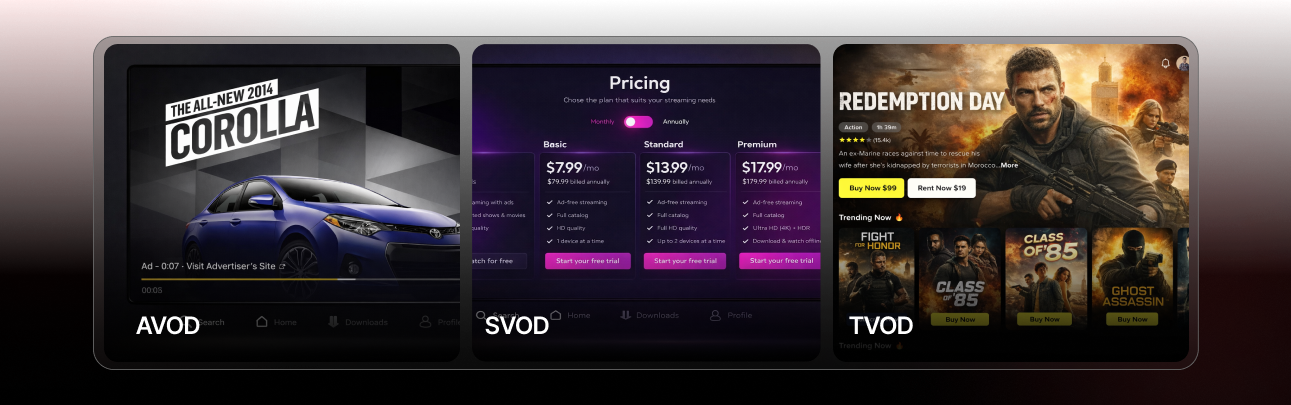
OTT monetization models are the specific business strategies streaming platforms use to generate revenue from video content. In India, the three primary models are:
AVOD (Ad-Supported Video on Demand): Users watch content for free, and platforms make money by showing advertisements (e.g., YouTube).
SVOD (Subscription Video on Demand): Users pay a recurring monthly or annual fee for unlimited, ad-free access to content (e.g., Netflix).
TVOD (Transactional Video on Demand): Users pay a one-time fee to rent or purchase specific pieces of content, like a new movie or live event (e.g., BookMyShow Stream).
The Big Three: AVOD vs SVOD vs TVOD India
To build a profitable platform, you must understand the mechanics behind each core OTT business model India relies on. Let us look at how they work, their pros and cons, and how they apply to the Indian market.
1. AVOD (Ad-Supported Video on Demand)
The AVOD model offers free access to users. Instead of charging the viewer, the platform charges advertisers for showing video ads before (pre-roll), during (mid-roll), or after (post-roll) the content.
Indian consumers love free content. Historically, television in India has been largely subsidized by advertisements, making AVOD a highly familiar concept to the average user.
Pros of AVOD:
Massive User Acquisition: Because it costs nothing to watch, AVOD platforms can rapidly build a massive audience.
Low Barrier to Entry: Viewers do not need credit cards or UPI setups to start watching.
High Advertiser Demand: Brands constantly seek large, engaged audiences to market their products.
Cons of AVOD:
High Infrastructure Costs: You pay server and streaming costs for every viewer, even if ad fill rates are low.
User Frustration: Too many ads can ruin the viewing experience and push users away.
Volume Dependent: You need millions of views to generate significant revenue, as ad rates (CPM) in India can be lower compared to Western markets.
Best Use Cases in India:
AVOD works best for platforms targeting Tier-2 and Tier-3 cities, where price sensitivity is high. It is also ideal for short-form content, news, user-generated videos, and massive catalog libraries of older movies and TV shows.
India-Specific Examples:
YouTube: The undisputed king of AVOD in India.
Amazon miniTV: A completely free, ad-supported streaming service built directly into the Amazon shopping app.
2. SVOD (Subscription Video on Demand)
SVOD requires users to pay a recurring subscription fee—usually monthly, quarterly, or annually. In return, they get complete access to a premium library of content, completely ad-free.
This is the most predictable video monetization strategy India has seen. However, Indian viewers are notoriously price-sensitive. To succeed with SVOD here, platforms must offer high-quality, exclusive content that viewers cannot find anywhere else.
Pros of SVOD:
Predictable Revenue: Recurring subscriptions provide steady, predictable cash flow.
Premium Brand Perception: Ad-free, exclusive platforms are viewed as premium services.
Better User Experience: No ad interruptions mean viewers stay engaged longer.
Cons of SVOD:
High Churn Rates: Users often subscribe to watch one specific show and cancel immediately after finishing it.
Expensive Content Acquisition: To justify a subscription fee, you need big-budget originals or exclusive rights to popular movies and sports.
Customer Acquisition Cost: Persuading an Indian consumer to pay upfront requires aggressive marketing.
Best Use Cases in India:
SVOD is perfect for platforms creating high-budget original web series, live premium sports (like international cricket), and exclusive blockbuster movie premieres. It works incredibly well for niche audiences who are willing to pay for highly specialized content (like foreign language dramas or exclusive educational content).
India-Specific Examples:
Netflix India: Relies entirely on the SVOD model, offering tiered pricing including an affordable mobile-only plan specifically designed for India.
Aha: A highly successful regional OTT platform that uses SVOD to cater exclusively to Telugu and Tamil audiences.
3. TVOD (Transactional Video on Demand)
TVOD operates on a pay-per-view basis. Users do not pay a recurring subscription. Instead, they rent or buy individual pieces of content.
This model essentially brings the movie theater or the DVD store directly to the user's living room.
Pros of TVOD:
High Revenue Per View: A single movie rental can bring in more revenue than an entire month’s ad impressions from a single user.
No Long-Term Commitment: Viewers who hate subscriptions prefer paying only for exactly what they watch.
Faster ROI on Premium Content: Excellent for new movie releases where production houses want to recoup costs quickly.
Cons of TVOD:
Inconsistent Revenue: Income fluctuates wildly depending on the popularity of your latest release.
High Friction: Asking users to pull out their wallets for every single video requires a lot of convincing.
Best Use Cases in India:
TVOD is ideal for early movie premieres (straight-from-theater releases), exclusive live concerts, stand-up comedy specials, or highly specialized masterclasses.
India-Specific Examples:
ZeePlex: Launched by ZEE to offer pay-per-view movie releases.
BookMyShow Stream: Allows users to rent or buy critically acclaimed and international movies without buying a subscription.
Comparison Table: AVOD vs SVOD vs TVOD
To clearly see how these platforms compare, review this breakdown:
| Feature |
AVOD (Ads) |
SVOD (Subscription) |
TVOD (Pay-Per-View) |
| Revenue Source |
Advertisers |
Viewer (Recurring) |
Viewer (One-time) |
| Viewer Cost |
Free |
Monthly/Annual Fee |
Per Video Fee |
| Content Type |
Older movies, short videos, and news |
Premium originals, live sports |
New releases, live events |
| User Barrier |
Very Low |
High |
Medium to High |
| Revenue Predictability |
Low (Depends on traffic) |
High (Recurring revenue) |
Low (Hit-driven) |
| Indian Examples |
YouTube, JioCinema (Free tier) |
Netflix, Aha |
ZeePlex, Prime Video Store |
The Hybrid OTT Model: The Future of Video Monetization in India
If you look at the most successful streaming giants in the country, you will notice a trend. They do not stick to just one model. They use a Hybrid OTT Model.
In India, a rigid SVOD-only approach alienates millions of potential viewers who cannot afford subscriptions. Conversely, a pure AVOD platform might struggle to fund expensive, high-quality original content. The solution is combining them.
Freemium: The King of Indian OTT
The most popular hybrid approach is the "Freemium" model (AVOD + SVOD).
Here is how it works: The platform offers a large library of older or mass-appeal content for free, supported by ads (AVOD). This brings millions of users through the door. Once the users are hooked, the platform restricts its absolute best content—like new blockbuster movies, live cricket, and premium ad-free experiences—behind a paywall (SVOD).
Why the Hybrid Model Wins in India:
Maximum Reach: You capture the massive, price-sensitive audience with free content.
Upsell Opportunities: You can convert loyal free users into paying subscribers over time.
Diversified Income: If ad revenues drop during a slow economic quarter, your subscription revenue keeps the business afloat.
India-Specific Examples:
Disney+ Hotstar: They perfected the freemium model. They offer daily soap operas and news for free with ads, but charge a subscription for premium originals, HBO content, and ad-free viewing.
ZEE5: Offers a massive catalog of free ad-supported television shows, while pushing users to subscribe for exclusive web series and straight-to-digital movie releases.
SonyLIV: Similar to ZEE5, offering catch-up television for free, while keeping live sports and premium originals locked behind a subscription.
Which OTT Monetization Model is Best in India?
There is no single "best" OTT revenue model for startups india can be universally used. The right choice depends entirely on your content, your target audience, and your capital.
Choose AVOD if:
You have a massive volume of content (like thousands of hours of local TV shows or user-generated videos).
Your primary target audience is in Tier-2 and Tier-3 cities, where willingness to pay is low.
You have deep pockets to sustain server costs while building a massive audience.
Choose SVOD if:
You create highly engaging, niche, or premium original content.
You target urban, affluent audiences in Tier-1 cities.
You want predictable, recurring revenue to fund future content production.
Choose TVOD if:
You are a production house releasing highly anticipated feature films.
You host exclusive live events (concerts, sports, spiritual gatherings).
Choose Hybrid if:
You want to scale aggressively and become a mainstream player.
You have both library content to attract the masses and premium content to drive subscriptions.
Before you make a final decision, you also need to factor in your initial development budget. Knowing the cost to build an OTT platform in India will help you determine how quickly your chosen monetization model needs to generate returns.
Real-World Use Cases for Indian Startups & Regional Platforms
The Indian OTT landscape is no longer just about Bollywood and Hollywood. Hyper-local, regional, and niche content platforms are thriving. Here is how startups are applying these models today:
1. Regional Language Platforms (SVOD + AVOD)
Platforms focusing exclusively on languages like Bhojpuri, Marathi, Gujarati, or Bengali are seeing explosive growth.
Strategy: Startups launch with a hybrid model. They offer classic regional movies for free (AVOD) to build a user base, then produce high-quality regional web series available only to subscribers (SVOD).
2. EdTech and E-Learning (SVOD + TVOD)
Education is massive in India. Tutors and coaching centers are building their own OTT platforms to stream lectures.
Strategy: Students pay a monthly subscription (SVOD) for general access to a library of subject videos. For highly specialized crash courses or guest lectures right before exams, the platform charges a one-time fee (TVOD).
3. Spiritual and Devotional Content (AVOD + TVOD)
India has a huge appetite for religious and spiritual content.
Strategy: Daily bhajans and satsangs are streamed for free with ads (AVOD). However, exclusive live streams of massive special events or personal consultations are sold as pay-per-view (TVOD).
4. Independent Filmmakers & Creators (TVOD)
Independent creators who cannot strike deals with Netflix or Amazon are launching their own micro-platforms.
Strategy: By hosting their own movie on a custom TVOD platform, they bypass the middlemen. They market directly to their social media followers, charging ₹99 or ₹149 per view, and keep 100% of the profits.
Launch Your Profitable Streaming Business with Regal Streaming Solution
Understanding how to monetize an OT platform in India is vital, but executing that vision requires world-class technology. You cannot afford platform crashes during a big release or payment gateway failures when users try to subscribe.
If you are a startup, content creator, or production house ready to launch your own streaming service, you need a reliable technology partner.
Regal Streaming Solution provides an end-to-end OTT platform development tailored specifically for the Indian market. Whether you want to launch a massive freemium service like Disney+ Hotstar or a niche regional SVOD app, we give you the tools to succeed.
Why choose Regal Streaming Solution?
Multiple Monetization Engines: Easily switch between AVOD, SVOD, TVOD, or Hybrid models with a single click.
Indian Payment Gateways Integration: Seamless integration with Razorpay, PayU, and UPI to ensure zero friction for your subscribers.
Scalable Architecture: Stream buffer-free content to users in Tier-3 towns with slow internet, just as easily as to users on 5G in Mumbai.
Robust Content Management: Upload, organize, and protect your videos with enterprise-grade DRM (Digital Rights Management) to prevent piracy.
Stop leaving your content revenue in the hands of third-party platforms. Own your audience. Own your platform.
Contact Regal Streaming Solution today and build the next big streaming platform in India!
Conclusion
The Indian streaming landscape in 2026 offers massive opportunities for those who understand how to extract value from their content. Knowing the difference between AVOD, SVOD, and TVOD is not just academic—it is the blueprint for your business survival.
To recap:
Use AVOD if you want maximum reach and have a massive catalog of content.
Use SVOD if you offer premium, exclusive viewing experiences and want predictable revenue.
Use TVOD for live events and high-demand single releases.
Use a Hybrid Model to capture the best of all worlds and dominate the Indian market.
Take the time to analyze your audience, your content library, and your capital. Align your monetization strategy with your target demographic. By choosing the right model and partnering with a robust technology provider, you can build a streaming platform that not only entertains India but generates serious, sustainable profit.
Frequently Asked Questions
Currently, the Hybrid (Freemium) model is the most profitable for large-scale platforms. It combines the massive reach of AVOD (ad revenue) with the stable, high-margin income of SVOD (subscriptions). For niche platforms, SVOD remains highly profitable due to predictable revenue.
Ad revenue (AVOD) depends on the CPM (Cost Per Mille/Thousand impressions). In India, video CPM rates vary wildly based on the niche and platform but generally range from ₹100 to ₹300 per thousand views. Mass platforms rely on millions of daily views to make AVOD profitable.
Yes. If you produce high-demand, exclusive content like new movies, live events, or premium workshops, TVOD is excellent. Users pay exactly for what they watch, making it a great OTT revenue model for startups in India looking to recoup production costs fast without managing monthly subscriptions.
India is a highly price-sensitive market with a long history of free, ad-supported television. Additionally, many users in Tier-2 and Tier-3 cities prefer not to commit to monthly recurring credit card or UPI mandates, making free, ad-supported content the easiest option.
Transitioning requires a careful strategy. Do not abruptly lock all your free content behind a paywall. Start by introducing a premium tier with exclusive, high-quality new releases, while keeping your existing library free. Communicate the value of the ad-free, premium experience to slowly migrate your loyal AVOD users to SVOD.


