

If you're a creator, content owner, or distributor running content on a white-label OTT platform, basic view counts are no longer enough. You need to know who is watching, how long they watch, which titles hold attention, and how much revenue your content generates.
The need is growing as creators become an increasingly large part of the media business. Goldman Sachs Research estimates the global creator economy could grow from $250 billion to $480 billion by 2027. Deloitte's 2025 Digital Media Trends also found that 56% of Gen Z and 43% of millennials surveyed consider social media content more relevant to them than traditional TV and movies, while roughly half of Gen Z and millennials report a stronger personal connection with social media creators than with TV personalities or actors.
Yet many white-label OTT platforms still focus analytics on the platform owner, not the people who own or distribute the content. A platform admin may see total subscribers and revenue, while a content owner needs title-level performance and revenue attribution, and a distributor needs catalog-level insights.
That's the Creator Analytics gap, and understanding why it exists matters when choosing a white-label OTT platform.
What Is a Creator Analytics Dashboard?
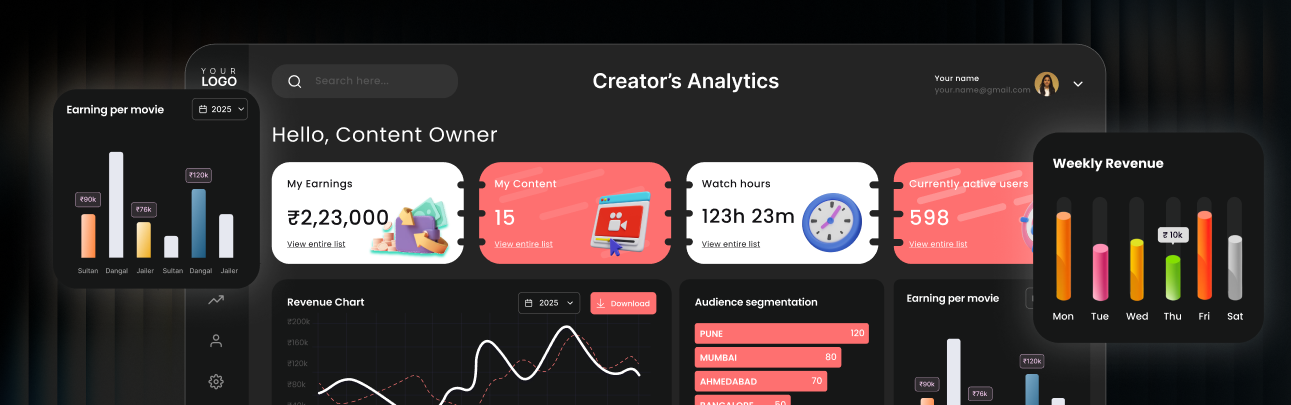
A Creator Analytics dashboard gives a creator, content owner, or distributor visibility into the performance of the content they actually own or manage, not just the overall performance of the OTT platform.
That distinction matters.
An OTT platform administrator may look at total subscribers, overall watch time, churn, and platform revenue. A content owner needs to know which of their titles are being watched, how long viewers stay, where they stop watching, and what revenue their content contributes. A distributor may need the same insights across an entire catalog.
A useful dashboard should therefore connect content performance with monetization. Depending on the business model, that can include:
Views, watch time, and audience retention
Drop-off and completion rates
Performance by title, episode, or series
Viewer geography and device usage
Revenue attributed to specific content
Revenue share and payout reporting
The key is attribution. If a platform generates $1 million in total revenue, that number alone tells a content owner very little. They need to understand what their content contributed to that result and how their earnings were calculated.
This is the gap between standard OTT platform analytics and genuine Creator, Content Owner, or Distributor Analytics. The first tells you how the platform is performing. The second tells your content partners how their business is performing.
Why Don't Most White Label OTT Platforms Offer Creator Analytics?
The real reason is usually not that OTT platforms cannot build an analytics dashboard. They can.
The bigger question is what the platform owner is willing to expose to creators, content owners, and distributors.
Once a platform gives a content partner detailed analytics, that partner can see more than views. They may be able to understand how their content performs, what revenue it generates, how revenue sharing works, and what they are actually earning.
For some OTT businesses, that level of transparency is difficult to provide for technical, operational, or commercial reasons.
1. The Platform Was Built for the OTT Owner, Not for Content Partners:
Most OTT platforms are designed around the needs of the business operating the service. The owner needs to track subscribers, watch time, streams, churn, and overall revenue. That model works well when the business owns its content and keeps all platform revenue.
The requirements change when the service includes multiple creators, content owners, studios, or distributors. The platform now needs to connect each title with its owner, track performance at the partner level, and determine which user is allowed to access that information. If the original architecture was not designed for this multi-party model, adding a genuine Creator Analytics or Content Owner Panel becomes a much larger product and engineering project.
2. Revenue Attribution Is Difficult to Calculate Correctly:
Showing total revenue is easy. Showing how much revenue belongs to each content owner is much harder.
Consider an SVOD platform where one subscriber watches content from five different content owners during a single billing period. The platform needs a defined method for allocating that subscription revenue. It could use watch time, consumption, a contractual revenue share, or a fixed licensing agreement. The answer depends on the commercial relationship.
The problem becomes even more complex when SVOD, AVOD, TVOD, advertising, discounts, refunds, and promotional offers are combined. This is why revenue reporting and revenue attribution are different problems. A platform can report how much money it collected without being able to accurately explain how much should be attributed to an individual creator or content owner.
3. Some Platform Owners May Not Want Full Revenue Transparency:
This is the commercial reason that is rarely discussed.
If a content owner receives detailed Creator Analytics, they may be able to follow the complete path from content performance to revenue generated, platform deductions, revenue share, and final payout. That can reveal exactly how much money the platform retains and how the partner's earnings were calculated.
Not every platform intentionally withholds this information. Some simply do not have the data architecture required to calculate partner earnings accurately. But in a revenue-sharing business, there can also be a commercial incentive to keep detailed financial information centralized. A basic payout statement gives the content owner the final number; a detailed Content Owner Analytics dashboard can give them the information needed to question how that number was reached.
For content owners, this distinction matters. Transparency is not just about seeing revenue, but it is about being able to understand the calculation behind the revenue.
4. Multi-Tenant Data Security Makes Partner Analytics More Expensive:
A creator should see their own content. A studio may need access to its entire catalog. A distributor may manage multiple content owners. The platform administrator may need access to everything.
That requires more than a login system. The platform needs proper tenant isolation and authorization so that one partner cannot access another partner's content, audience, or financial data. AWS's SaaS architecture guidance specifically distinguishes authentication from tenant isolation and recommends mechanisms that prevent one tenant from accessing another tenant's resources.
For a white-label OTT platform, this means a Creator Analytics dashboard requires additional work across content ownership mapping, permissions, data isolation, and reporting. That increases development and infrastructure costs compared with a single administrator dashboard.
5. The Feature Benefits Content Partners More Than the Platform Owner:
OTT vendors naturally prioritize their OTT features that help their primary customer launch, monetize, and operate the service. Subscription management, payment processing, DRM, content management, apps, advertising, and viewer analytics directly support the platform owner's business.
Creator Analytics serves a different stakeholder: the creator, content owner, or distributor.
If most customers using the platform own their own content, a vendor may see little commercial pressure to build a separate partner analytics layer. As a result, a platform can have sophisticated viewer analytics while still offering no meaningful Content Owner Analytics.
6. Manual Reporting Can Look Sufficient Until the Number of Partners Grows:
For a platform working with a small number of content partners, manual reporting may seem practical. A content owner requests a report, the operator exports the numbers, finance checks the payout, and the report is delivered.
The problem is scale.
When dozens or hundreds of creators, studios, or distributors are involved, the same process creates recurring administrative work. A self-service Creator Analytics Panel allows partners to check performance and earnings themselves, reducing dependence on the platform team for routine reporting.
So the absence of Creator Analytics is not only a transparency issue. It can also become an operational limitation as the OTT content ecosystem grows.
7. Platform Owners May Treat Audience Intelligence as Internal Business Data:
Detailed analytics can reveal commercially valuable information: which titles attract viewers, which content retains them, which markets perform best, and which programs contribute to subscriber growth.
A platform owner may reasonably keep some overall business intelligence private. The problem is when that approach extends to data that a content owner needs to understand the performance of their own content.
A sensible analytics architecture can separate the two. The platform owner retains access to platform-wide intelligence, while the creator or content owner receives secure access to their own content performance and earnings.
The challenge is deciding where that boundary should sit.
8. Many Platforms Do Not Need Creator Analytics for Their Core Business Model:
Creator Analytics is not equally important for every OTT business.
A platform that owns all of its content and does not share revenue with external partners may have little reason to build a dedicated Content Owner Panel. Its primary requirement is understanding the performance of the overall streaming service.
The requirement changes when the business licenses content from multiple owners, works with independent creators, manages third-party studios, partners with distributors, or shares subscription and advertising revenue.
In those models, Creator Analytics becomes part of the operating infrastructure, because multiple parties have a legitimate interest in understanding how their content performs and earns money.
9. The Creator Economy Is Growing, Increasing the Need for Better Content-Level Data:
The demand for creator-level analytics is becoming more relevant as creators increasingly operate as independent media businesses. Goldman Sachs Research estimated that the global creator economy could grow from approximately $250 billion to $480 billion by 2027 and identified improved tools, monetization, and data capabilities as important parts of the ecosystem's continued development.
For OTT platforms, this creates a clear expectation gap. A creator who is accustomed to seeing detailed performance data on major digital platforms may expect similar visibility when launching an independent streaming service.
A dashboard showing only total subscribers and platform revenue answers the needs of the OTT operator. It does not necessarily answer the questions of the content owner whose videos, films, or series generate that activity.
10. The Core Issue Is Not the Dashboard, but It Is Control Over Data:
Ultimately, the reason most white-label OTT platforms don't offer detailed Creator Analytics comes down to a combination of product architecture, cost, revenue attribution, and data control.
The platform needs to decide who owns the data, who can access it, how revenue is attributed, and how much financial information is shared with each content partner.
For some vendors, the technology was never designed for multi-party content businesses. For others, the OTT cost and complexity may not justify the feature. And in some revenue-sharing models, keeping detailed earnings and attribution data centralized may be commercially preferable.
That is why you should never assume that an OTT platform with an analytics dashboard automatically provides Creator Analytics.
Platform Analytics answers:How is my OTT business performing?
Creator Analytics answers: How is my content performing?
For a multi-content OTT business, those are not the same questions, and they should not be answered by the same dashboard.
What Should a Creator Analytics Dashboard Actually Show?
A useful Creator Analytics dashboard should help a creator, content owner, or distributor answer three questions: How is my content performing? Who is watching it? And what revenue is it generating? The exact metrics depend on the OTT business model, but these are the core capabilities to look for.
Content Performance Analytics:
The dashboard should show title-level performance such as views, unique viewers, watch time, average viewing duration, completion rate, and engagement trends. A creator should be able to see which videos perform best, while a content owner should be able to compare movies, series, seasons, or episodes. A distributor should also be able to aggregate performance across its entire content portfolio rather than reviewing titles individually.
Audience Analytics:
Content partners should be able to understand who is watching without receiving unnecessary personal information. Useful insights can include viewer geography, device usage, new versus returning viewers, audience growth, viewing frequency, and retention trends. For example, a distributor may discover that a particular genre performs strongly in one region, giving it a better basis for future licensing, promotion, or content acquisition decisions.
Content-Level Filtering:
A serious dashboard should allow analytics to be filtered by movie, series, season, episode, channel, live stream, or category. Aggregate platform numbers can hide important patterns—for example, a series may have strong overall viewing, while one season or a small group of episodes generates most of the engagement. Content-level filtering makes those patterns visible.
Revenue Analytics:
This is where Creator Analytics becomes commercially useful. Depending on the OTT monetization models, the dashboard may show gross revenue, net revenue, revenue by title, SVOD-attributed revenue, AVOD revenue, TVOD or PPV revenue, advertising revenue, platform fees, revenue share, and payouts. The key requirement is clarity: the platform should explain what each figure represents and how the final earnings number was calculated.
Revenue Attribution:
The most valuable feature is the connection between content performance and money. A platform administrator may see $1 million in total revenue, but a content owner needs to understand their content views, watch time, attributed revenue, revenue share, and final payout. A distributor may need the same information across its portfolio, broken down by title, territory, or monetization model. This is what separates a genuine Content Owner Analytics system from a basic OTT reporting dashboard.
The Bottom Line:
A good Creator Analytics dashboard should not simply tell content partners how many people watched their content. It should help them connect content performance → audience behavior → monetization → attributed revenue → earnings. That is the information a creator, content owner, or distributor can actually use to decide what to promote, license, produce, or invest in next.
Why This Actually Matters for Content Owners and Distributors
Without Creator Analytics, content owners and distributors often have to make decisions with only partial information. The OTT platform may have detailed data internally, while the content partner sees only basic reports or a final payout.

The real issue is information imbalance.
If the OTT platform can see detailed content and revenue data while the content owner sees only a final payout, the platform controls most of the information about the content's commercial performance.
A proper Creator Analytics, Content Owner Analytics, or Distributor Analytics system creates a more transparent relationship. Partners can see the performance and earnings data relevant to their own content without gaining access to unrelated platform-level information.
For revenue-sharing OTT businesses, Creator Analytics is therefore not just a reporting feature. It is part of the trust and accountability between the platform and the people whose content generates its business.
Regal Streaming Solutions: A Self-Hosted White Label OTT Platform Offering Creator Analytics

Regal Streaming Solutions takes a different approach by offering a Creator Analytics dashboard for content owners and distributors, not just the OTT platform administrator.
Its self-hosted white-label OTT model is designed to give businesses greater control over their platform and data, while its analytics layer can provide content-level insights such as watch time, engagement, audience geography, device usage, and revenue attribution.
For OTT businesses working with multiple creators, content owners, or distributors, this addresses a common gap: giving partners visibility into how their own content performs and generates revenue, rather than limiting analytics to platform-wide numbers.
The result is a more transparent approach where Creator Analytics becomes part of the platform infrastructure, not just an admin-only reporting feature.
Launching Your First OTT Platform? Ask These Questions Before Choosing a White Label OTT Vendor
If you're a content creator, content owner, studio, or distributor building your first OTT platform, don't stop at asking a vendor, "Do you have analytics?"
Ask whether the platform can give the right analytics to the right people.
Creator Analytics:
Can creators, content owners, and distributors have separate logins to view the performance of their own content?
Content-Level Analytics:
Can users track performance by movie, series, season, episode, or individual title instead of seeing only platform-wide numbers?
Distributor Analytics:
Can distributors view and compare performance across the multiple titles or content catalogs they manage?
Revenue Analytics:
Can the platform show revenue attributed to specific content, content owners, or distributors? Can users understand the difference between gross revenue, net revenue, revenue share, and final payouts?
Revenue Attribution:
Can the vendor clearly explain how revenue is attributed when content is monetized through SVOD, AVOD, TVOD, PPV, or advertising?
Access Control:
Can each content partner see only the data they are authorized to access, while distributors can securely manage multiple catalogs?
Reporting:
Can content partners filter custom date ranges, access historical performance, and export their reports for internal analysis?
The most important question: Can my content partners independently see and verify the agreed performance and revenue data for their own content?
If the answer is no, don't assume the platform's standard admin analytics will be enough. Clarify exactly what content owners and distributors can see before you commit to the platform.
Conclusion
Most white label OTT platforms don't offer a Creator Analytics dashboard because it's expensive to build, wasn't part of the original design, and — in a lot of cases — because full transparency isn't in the platform owner's financial interest. That's the uncomfortable part of this conversation, but it's the accurate one.
If you're a content owner or distributor, treat analytics access as a requirement, not a nice-to-have. Ask for it directly before signing anything. And if you're evaluating self-hosted options, look closely at platforms like Regal Streaming Solution that are actually building this in rather than treating it as an upsell.
Frequently Asked Questions
The administrator is usually the primary customer of the OTT platform, so the product is designed around managing the overall service. Creator-level reporting requires a separate data and permission structure for external content partners, which many platforms don't include in their standard product architecture.
Not necessarily. Many platforms can report total subscription, transaction, or advertising revenue at the service level, but calculating and reporting revenue for individual creators, content owners, or distributors requires an additional attribution layer. This is particularly challenging when multiple content partners contribute to the same subscription-based service.
The content owner becomes dependent on the platform operator for reporting and may have limited ability to evaluate content ROI, identify underperforming titles, or verify the commercial value of their catalog. Over time, this can create friction in licensing, revenue-sharing, and distribution relationships.
A single-owner OTT service can aggregate most of its data around one business. A multi-party service must separate data by creator, content owner, distributor, and sometimes contractual rights. The platform therefore has to manage different levels of access and reporting without exposing another partner's information.
It is likely to become more important as OTT businesses increasingly work with external creators, studios, and content distributors. The pressure will come from the business model itself: as more parties contribute content and participate in monetization, they will have stronger reasons to demand direct visibility into performance and earnings.


